Spirituality & Religion

All posts tagged Spirituality & Religion

Paradise not Lost

Published 22/09/2012 by inspiringyourspirit

Open your eyes to the true beauty that Mother Nature has to offer! See the richness of color from the Azure Blue Pacific Ocean to the whiteness of the clouds and the lush greens from the palms of the coconut tree, what’s not to love? I can feel the warm breeze on my face, smell the intoxicatingly sweet scents from the Coconuts and Fairmont Orchids and taste the salt in the air from the ocean spray as the droplets are carried far and wide in the wind.
Hawaii, a beautiful place, a spiritual place..Paradise on Earth!
Let’s work together as one and protect this beauty for all generations to come…Please don’t let it fade away!
Namaste
Mark

Observations

Published 19/09/2012 by inspiringyourspirit

The ancients first began accumulating wisdom when they came upon the idea that one could be the observer. They would watch the way things worked without prejudgment. They did this not only with nature, but also with human interactions.

The more they watched, the more they recognized patterns in everything. In Nature, they began to understand the cycles of life. Among people, they saw actions and reactions, relationships and conflicts. They began to record their insights about these patterns, and their writings were collected in ancient classics like the I Ching.

One interesting benefit of being the observer is the clarity that comes to play. When you look at an event with impartial detachment, you can see far more than the people who are in the thick of it. They have a limited view of what is in front of them instead of an expanded view that takes everything around them into account. Detached observation is what gives sages the clarity to solve seemingly impossible problems; they watch and understand before deciding on a course of action.

Practice being the observer. Watch yourself go through your activities today as if you were watching a movie. If you are driving and someone cuts you off, take a step back mentally and watch how you react, and notice how you deal with road rage much more easily in this frame of mind.

Derek Lin

Namaste

Mark

Valuable Resources

Published 17/09/2012 by inspiringyourspirit

The all-encompassing Tao includes all of us, the good as well as the bad. It is easy for most of us to embrace the good, but how can we embrace the bad when we want to distance ourselves from them?

Some may suggest that this is a distinction between good and bad in the Tao, but this is not quite correct. The actual teachings are quite specific about this, and instruct us to approach the two sides differently.

Chapter 27 of the Tao Te Ching tells us to regard the good people as models to emulate. It also tells us that those who lack the wisdom to handle life skillfully are demonstrations of what to avoid. There is always something we can learn from them, so they are our resources. In that sense, they are no less valuable than the good people who are our teachers.

Identify the resources in your life and consider specific ways they serve as counterexamples. Do they treat others poorly? Are they inconsistent in what they say and do? Do they have trouble facing the frustrations in life? For every area where they lack skills and wisdom, think about how you would handle the same thing with greater composure and effectiveness.

Derek Lin

Namaste

Mark

The Five Elements

Published 15/09/2012 by inspiringyourspirit

The Five Elements

The five elements of the ancient Chinese are metal, wood, water, fire and earth. These elements interact with one another i8n specific and fascinating ways. For instance, when we burn logs, we can see that wood produces fire. When the fire burns out and only ash remains, we say that fire produces earth. When we think about a mining operation, we say that earth produces metal. When water condenses on a metallic surface, we say that metal gives rise to water. Finally, when we onserve trees requiring water to grow, we say that water gives rise to wood. This completes tyhe cycle.
In Chinese culture, people apply the five elements to everything from acupuncture, medicine and feng shui to human reactions. They illustrate the cyclical nature of the world and our dealings with one another. They also give us a glimpse into the workings of karmic connections.Why is it that some people benefit you but not others? Why is it that a friend of a friend may be someone you do not particularly like? The five elements can give you insights into various life situations.

Five Chinese Elements - Diurnal Cycle

Five Chinese Elements – Diurnal Cycle (Photo credit: Wikipedia)


Think about your nature. Which element best describes your primary mode of being? Are you down-to- earth? Do you have a fiery temper? Are you nurturing like water? Do you possess a steely resolve? Are you in tune with nature like wood? Think about the people who have always been good to you, and match their nature to the element that is beneficial to yours. Let the five elements help you find the harmonious optimum in your relationships.

Derek Lin

Namaste

Mark

Morning Prayers

Published 13/09/2012 by inspiringyourspirit

Firmness is incomplete
Without softness to receive it.
Embrace these two,
And a child is formed,
Perfect, innocent, and free.

Give to the day
Receive from the night;
Honor these two,
Become the ritual of life.

Live your highest aspirations
In an unassuming way:
Cupped hands at the crystal spring.

Be the lump of clay
And the sculptor too:
A universe of unlimited potential.

Haven tevino

Namaste

Mark

The Taoist Way

Published 12/09/2012 by inspiringyourspirit

Taoism, along with Confucianism and Buddhism, is one of the three great religions of China. The founder of Taoism is beleived to have been Lao-Tsu 老子(604-531 BC), he was also the author of the Tao-te-Ching. His association with the TΓ o TΓ© ChΔ«ng has led him to be traditionally considered the founder of philosophical Taoism (pronounced as “Daoism”). He is also revered as a deity in most religious forms of Taoist philosophy, which often refers to Laozi as Taishang Laojun, or “One of the Three Pure Ones”.

According to Chinese traditions, Laozi lived in the 6th century BCE. Some historians contend that he actually lived in the 5th-4th century BCE, concurrent with the Hundred Schools of Thought and Warring States Period, while some others argue that Laozi is a synthesis of multiple historical figures or that he is a mythical figure.

A central figure in Chinese culture, both nobility and common people claim Laozi in their lineage. He was honored as an ancestor of the Tang imperial family, and was granted the title TΓ‘ishāng xuānyuΓ‘n huΓ‘ngdΓ¬, meaning “Supreme Mysterious and Primordial Emperor”. Throughout history, Laozi’s work has been embraced by various anti-authoritarian movements.

Lao-Tsu created a philosposhy and way of life that is peaceful and in harmony with nature. Taoism has influenced acupuncture, holistic medicine and martial arts such as Tai Chi and Chi Kung. The Yin/Yang is a well known Taoist symbol showing two curved shapes within a circle, one black and one white, each containing part of the other.
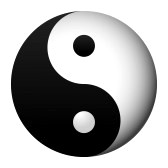
It symbolises any two dualistic forces, such as light and dark, male and female.

Meditation.

Practice this form of meditation when you feel you need to be more connected and in harmony with nature.

1) Sit or stand near a river or stream at a spot where you can be quiet and undisturbed. Breathe deeply for a few minutes to quieten and center your mind.

2) Notice how the water flows over and around the rocks or tree roots. Contenplate how life is more harmonious when you do not resist it or go against it.

The Taoist term Wu-Wei means ‘Not Forcing’, it means going with the flow or swimming with the current rather than against it. It means not winning in order to achieve higher goals.

3) Contemplate how you feel when trying to force an issue or make something happen according to your wishes. Even if you do get your way, how do you feel being in conflict and competition with others? Was that the best approach for all involved?

4) Wu-Wei is an approach to life in which you observe the flow of energy and human behaviour and choose the most harmonious way of dealing with it. Observe the stream and how water flows by choosing the path of least resistance. How can you use this wisdom of nature to make your life and the lives of those around you more peaceful and harmonious?

Namaste

Mark

Consciousness and Love

Published 11/09/2012 by inspiringyourspirit

You, wayfarer in the universe
who go through life like a meteor,
make sure your fall into the void is not in vain
do not go straight from nothing to nothing
but give a meaning to your fleeting presence
in this fleeting reality
cultivating the most sublime of achievements
and the highest goal of Consciousness
which makes Matter great:
Love through non-attachment.
A buddha is inside you:
make him grow until you become
another of his incarnations.
In the eternal flow from nothing to nothing
make sure that between one nothing and the other
Consciousness and Love
take their place in the evolution
of this universe.

Giulio Cesare Giacobbe.

Namaste

Mark

Personal Energy

Published 10/09/2012 by inspiringyourspirit

Attune yourself to personal energy
Feel it flow like water,
Jagged stones of firm belief
Smoothed into nothing;
Cleansing, clearing, nurturing, healing.
Follow it faithfully, honestly, spontaneously,
Let it empower and serve.

Emotions are energy, too.
When they flow the most
They hurt the least.

Namaste

Mark

Living in the Now

Published 07/09/2012 by inspiringyourspirit

Some say that living in the now is absurd and irresponsible.
How can you trust those who might harm you?
How will you survive without planning and toil?
How can you heal without first being schooled?
Fear of Death,
Fear of Want,
The fear of seperation from God.

To choose to trust allows the fullest expression of life.
To choose to serve creates the greatest abundance.
To choose compassion brings Oneness and Health.
Vvalues found only moment by moment.
Banishing all fear.
The only rational response to life.

Namaste

Mark

The Shining Light of Buddha

Published 06/09/2012 by inspiringyourspirit

Quiet the mind
Be still
And watch the breath of God
Rise and fall
in all things.
Allow God’s breath
To be your breath;
Allow God’s nature
To be your nature.

The nature of God
Is to love and be loved;
Your desire to love creates intention,
Intention focuses attention,
Attention illuminates understanding,
Understanding manifests forgiveness,
Forgiveness is the fountainhead of love.

Intend to be Love
And know death for what it is:
The unbreath of God.

Haven Trevino

Buddhist Prayer Ribbons

Published 05/09/2012 by inspiringyourspirit

Red Silk Prayer Ribbons.

Used in Buddhist temples to offer prayers to the Buddha, pass on your wishes to the Buddha, love to loved ones, deceased relatives and friends.

Whatever way you choose to pray or send out your message and to what ever enity, god or higher power you choose to send it to, do it with love, send the message from your heart with pureness of mind without any attachments and send it with pure intention. The quality of intention on the object of attention orchestrates an infinity of details to bring about your intended outcome.

ANTAHKARANA – ANCIENT SYMBOL OF HEALING

Published 04/09/2012 by inspiringyourspirit

ANTAHKARANA – ANCIENT SYMBOL OF HEALING.

A very interesting article regarding ancient symbols for healing posted on the Ascension Network.

Namaste

Mark

Thought on Today

Published 04/09/2012 by inspiringyourspirit

Today is a grey day, the rain is heavy but there is still beauty to be seen, the birds are still singing and there is peace in the quietness, only the rustle of the leaves and drops from the rain can be heard. Embrace the beauty, enjoy the light and feel the rain on your face πŸ™‚

..Tranquility…Peace…Love and Light.