I love this short video ‘What the internet is doing to our brains’. We all get caught up in it, our days are full of distractions, information comes at us from every angle from the moment we awake to the moment we go to sleep, TV, Radio, Newspapers, Smart Phones, tablets, Computers and of course the never ending stream of information and disturbances from the internet, emails, text messages, chats etc.
We have no time to take a time out, to calm our minds and to just ‘Sit’ ‘to do nothing’, ‘to reflect’, ‘to look inside’ and ‘enjoy our time with ourself’, ‘connecting with your soul’.
If you meditate, you know how powerful even 2 minutes of meditation can be for you, how these two minutes can calm your mind, take you to a place of total relaxation, away from the daily stresses and leave you fully in the ‘Present Moment’
Enjoy the video and take a moment from your day and be at one with yourself.
Listen to the sound of the bell and allow your mind to return to the garden of your heart and see the flowers of peace bloom.
It’s early on Sunday morning here in Shanghai, and before i head out for the day with my camera on to the streets of Shanghai I wanted to share this beautiful video with you, i’m sure some of you may of have already seen it but I’m also sure you will be happy to watch and listen to its beautiful message again.
Please sit back, put your headphones on, turn up the sound a little, relax, enjoy the peace and the miracle that happens in our world of nature.
We all do it!…Hold on to memories, good or bad, problems, issues, traumas, past experiences that tie us down and stop us from flying free, but why?
It happens to the best of us.
We do our best to be positive, to meditate, to be in the ‘Now’, in the ‘Moment’ we try to push away the past, forget about thinking of the future and live for today, for this special ‘moment’ in time that we are experiencing right here, right now.
But then it comes back to haunt us again, our ‘Ego’, testing us, bringing us to task and remembering to remind us of the past and to re-direct our thoughts to the future too…
I was again at this very point yesterday morning, questioning myself yet again, ‘Why Me, Why Now’..testing my inner self re my own spiritual journey, the pathway i’m on and the reasons why i’m walking this pathway of spiritual healing. Also questioning why I have been blessed (or is it cursed) with these gifts that have for some reason been bestowed on me!… So to gain some clarity and to help stop my Ego in its tracks I decided to meet with a Buddhist Monk friend of mine yesterday, we sat, meditated, shared our passions for humanity and talked about this and that, we shared stories, we laughed and we smiled, a lot 🙂 I opened my heart, I cried a lot especially regarding my own suffering for the suffering i see and feel from others, we discussed my journey and my mission. We prayed and shared the spiritual love and compassion of the Buddha and then it happened, as if by magic….A clearing of my mind, peace and Joy was once more back in my heart and in my mind.
My Ego was gone and I was in the ‘Now’ once again, I let myself…. ‘Just Be’…
Namaste my friends
May your weekend be filled with Love, with Joy and may your face be filled with the most wonderful Smile 🙂
No pain that we suffer, no trial that we experience is wasted. It ministers to our education, to the development of such qualities as patience, compassion, faith, fortitude and humility. All that we suffer and all that we endure, especially when we endure it patiently, builds up our characters, purifies our hearts, expands our souls, and makes us more tender and charitable so that we can continue to do good for others.
Yesterday I fumbled, I got myself lost on my spiritual journey, I faltered and questioned ‘Why Now, Why Me’! I took the time to ‘Think Too Much’ and allow my ego to have a place in my mind, to question me as to why i was on this pathway!…It took me sometime to bring my mind back into the ‘Now’ to push these thoughts away and to clear my mind, it also helped to receive some encouraging replies to my post from some dear blogging friends (Heidi, Frank and Rising Hawk) their comments can be seen following the blog post as can their contact links if you would like to check their blogs out too 🙂
Today is a different day, the sun is shining, I awoke with a clear mind after a refreshingly good nights sleep, I’m looking forward to my day with a smile on my face and I’m carrying on my spiritual journey with gusto 🙂
Wow, this is so amazing, Miyoko Shida Rigolo performing a beautiful act of mindfulness, concentration, balance, poise and beauty…Please watch to the end, its amazing and brought a tear to my eye 🙂
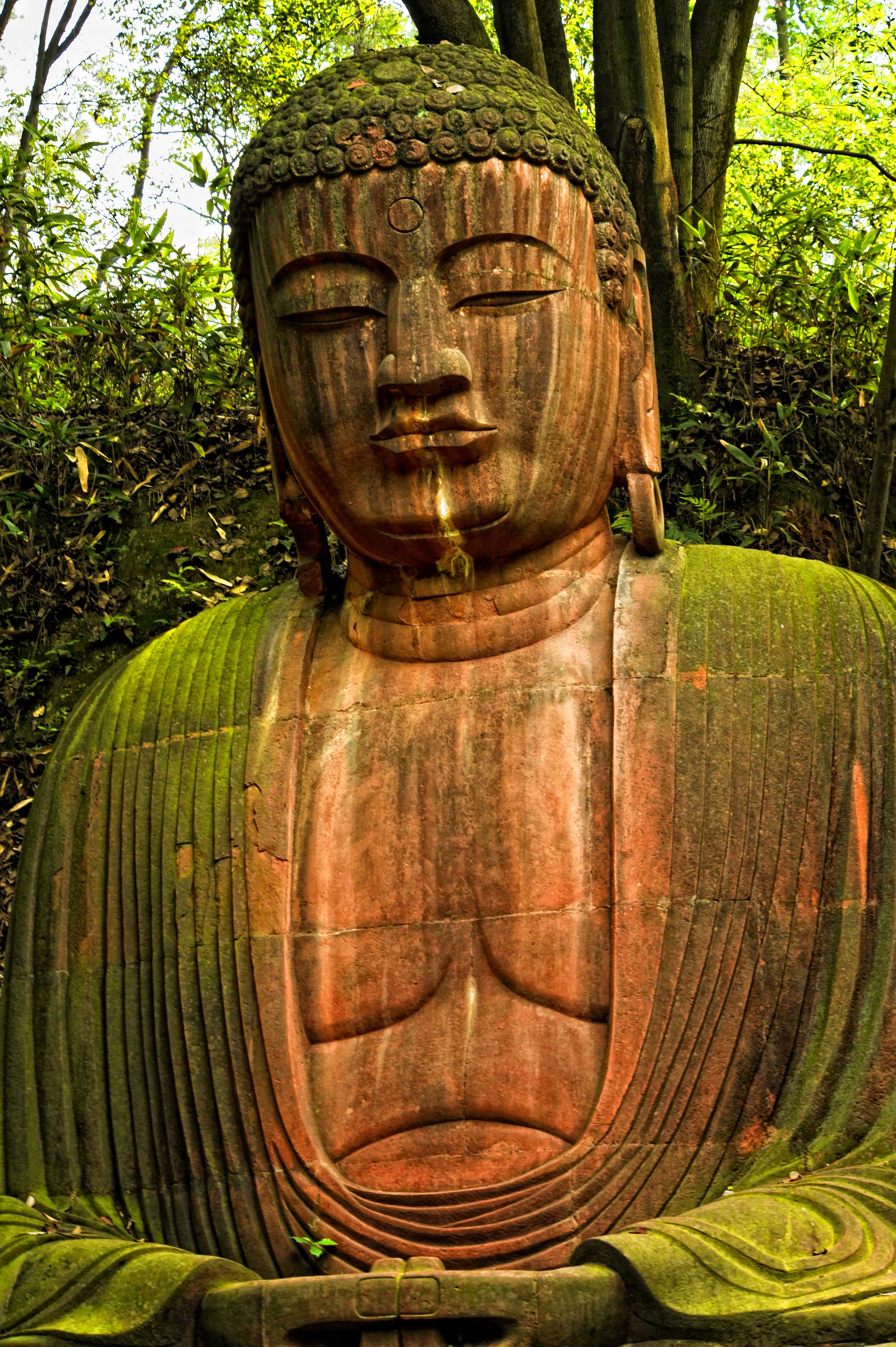
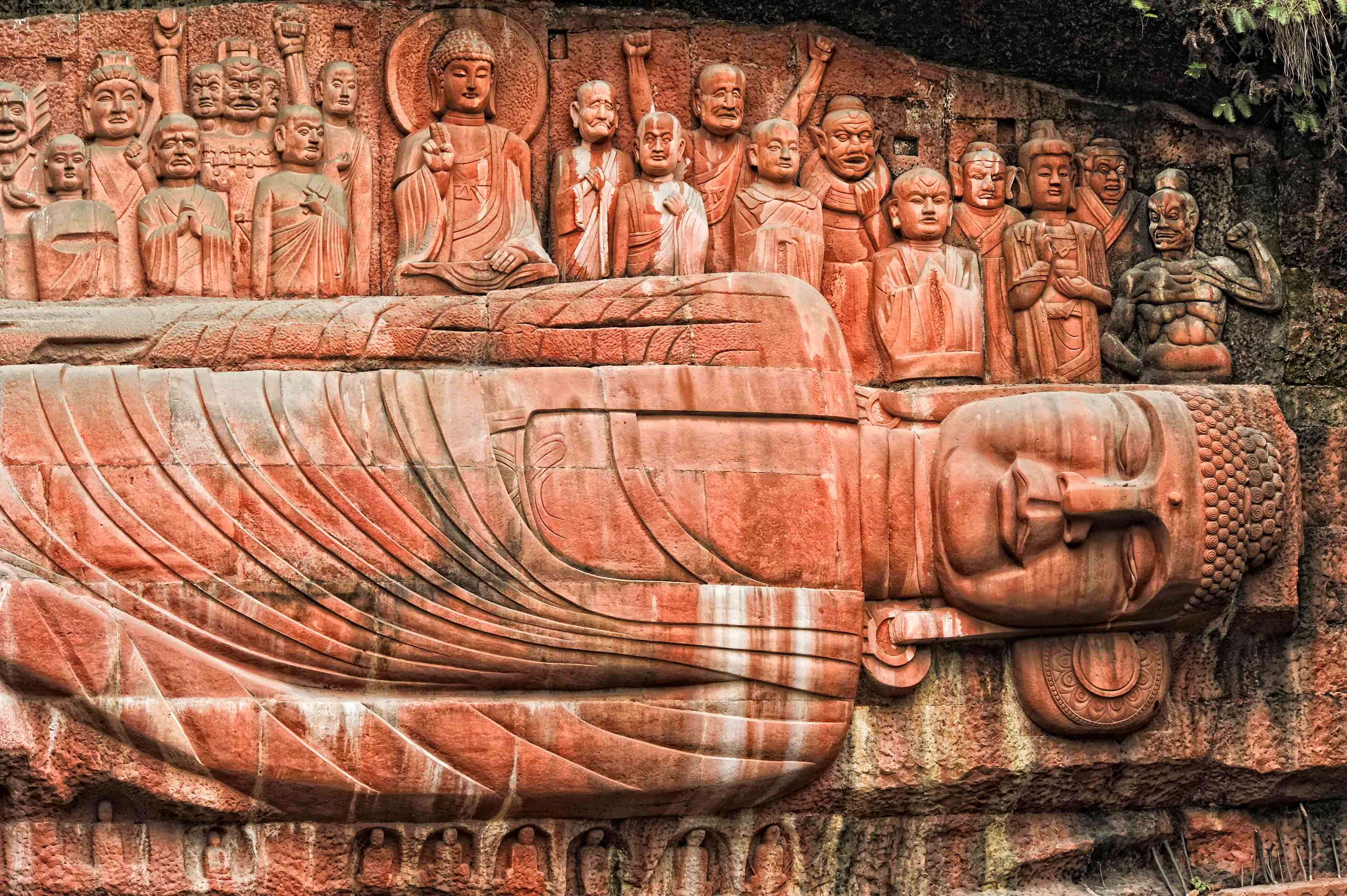
More images taken on our visit to Leshan, Sichuan Province, China to see the largest Buddha in the world Dafo. The walk through the gardens surrounding the temple and Dafo is so beautiful and peaceful, you can gain inspiration, gather your thoughts, be in ‘The Moment’ and really feel ‘Life’.
“Some people do not know the difference between mindfulness and concentration. They concentrate on what they’re doing, thinking that is being mindful. . . . We can concentrate on what we are doing, but if we are not mindful at the same time, with the ability to reflect on the moment, then if somebody interferes with our concentration, we may blow up, get carried away by anger at being frustrated.
If we are mindful, we are aware of the tendency to first concentrate and then to feel anger when something interferes with that concentration. With mindfulness we can concentrate when it is appropriate to do so and not concentrate when it is appropriate not to do so. ”
~ Ajahn Sumedho
Every time you are tempted to react in the same old way, ask if you want to be a prisoner of the past or a pioneer of the future. The past is closed and limited, the future is open and free.
– Dr. Deepak Chopra
Mark with Dr. Deepak Chopra in China.
In practical terms surrender means letting go. Although you don’t realize it, reality isn’t a given. Each of us inhabits a separate reality. Your mind maintains your personal version of reality by buttressing it with beliefs, expectations, and interpretations. Your mind blocks the free flow of the life force by saying, “This is how things must and should be.” Letting go releases you from the insistent grip, and when you let go, new forms of reality can enter.
You only have to take a ride on a roller coaster to see who gets more enjoyment out of the experience, those who clutch tight with white knuckles and clenched jaws or those who let go and allow themselves to be carried up and down without resistance.
Letting go is a process. You have to know when to apply it, what to let go of, and how to let go. Your mind is not going to show you any of these things; worst still, your ego is going to try to prevent you from making progress since it believes that you have to hold on in order to survive. Your only ally in letting go is spirit, which sees reality as a whole and therefore has no need to create partial realities based on limitation.
The whole path to love could be described as learning to let go, but letting go all at once isn’t possible. This is a path of many small steps. At any given moment the steps are basically the same: awareness begins to substitute for reactions. A reaction is automatic; it draws upon fixed beliefs and expectations, images of past pain and pleasure residing in memory, waiting to guide you in future situations.
Overcoming any reaction requires an act of awareness. Awareness doesn’t resist the imprint of memory. It goes into it and questions whether you need it now. In the face of a big dog, awareness tells you that you aren’t a small child anymore and that not all big dogs bite. Being aware of this you can ask if you need to hold on to fear. Whether you wind up petting the dog, ignoring it, or withdrawing is now a matter of choice. Reactions result in a closed set of options: awareness results in an open set of options.
When to let go
The critical times to let go are when you feel the strongest urge not to. We all hold on tightest when our fear, anger, pride, and distrust take over. Yet these forces have no spiritual validity. At those moments when you are afraid, angry, stubborn, or mistrustful, you are in the grip of unreality. Your ego is forcing you to react from the past, blinding you to new possibilities here and now. Spirit has a good outcome for any situation, if you can open yourself to it.
What to let go of
If the right time to let go is when you don’t want to, the thing to let go of is the thing you feel you must hold on to. Fear. Anger, stubbornness, and distrust portray themselves as your rescuers. Actually those energies only make you more closed off. For example, panicky people tend to act that way because it is familiar; the same is true for angry and stubborn people. It is helpful to challenge familiar reactions by stating that you no longer believe in them. Here are a few examples: Instead of saying “I have to have my way,” say to yourself, “I don’t know everything. I can accept an outcome I can’t see right now.” Instead of saying” I’m incredibly afraid,” say to yourself “fear isn’t me” Being more afraid doesn’t make it any more real.” (This technique is also applicable to feelings of overwhelming anger, distrust, rejection, anxiety, and so forth).
How to let go
Since letting go is a deeply personal choice you are going to have to be your own teacher. The process takes place on every level—physical, mental, emotional—where energy can be stuck or held and no two people have exactly the same issues. You may feel comfortable with a lot more physical release than I do; I may feel comfortable with a lot more emotional release than you do. It is important to find the balance between physical, mental, and emotional release that works for you.
I also suggest that you embrace the following ideas as appropriate:
-This is just an experience. I’m here on earth to have experiences. Nothing is wrong. -My higher Self knows what is going on. This situation is for my benefit, even if I can’t see that now. -My fears may come true, but the outcome will not destroy me. It may even be good. I’ll wait and see. -I’m having a strong reaction now, but it isn’t the real me. It will pass. -Whatever I am afraid of losing is meant to go. I will be better off when new energies come in. Whatever fear says, nothing can destroy me. -When people fall they don’t break, they bounce. -Change is inevitable. Resisting change doesn’t work. -There is something here for me, if I have the awareness to find it. -The things I fear the most have already happened. I don’t want to hold on anymore. My purpose is to let go and welcome what is to come. -Life is on my side. -I am loved, therefore I am safe.
I encourage you to embrace the coming season with a sense of openness, vitality, and a renewed sense of pure potentiality.
Wow, I receive a very profound question from one of our fellow bloggers bert0001 in regard to one of my recent posts ‘Mindfulness’, as follows :-
“I have a profound question here. I wrote a post last week about the difference between awareness and metacognition. And here I see mindfulness. I know that this has been around for 25 years in the Western Hemisphere and that it is a watered down version coming from buddhism. But in a way, this video makes me pleasantly agitated. There is no answer here. It is like publicity for sigarets. And if I walk around the internet, I see 700 different interpretations of mindfulness, awareness, metacognition and so on.
Many people, if not most think that meditation is sitting cross legged, listening to Enya in the vicinity of a candle and some incense.
So let me come back to the question. Could you give a concise and correct definition of mindfulness, in respect with my brain and mind, so that people know when they are mindfull and when they are mindless. (like me right now )”
Well, as I replied to bert0001, this is certainly a very profound question and one in which I’m sure is debated and contested on a daily basis all around the world especially between Scientists of the Mind and Traditional Religions and Buddhism followers across the globe. So in order for me to try and reply to bert0001’s question as best as possible I have attached two items to this post, the first one is an article by Thanissaro Bhikkhu re a definition of Mindfulness from a Buddhist perspective and the second a YouTube video by Professor Mark Williams from Oxford University Science who provides in my mind an excellent presentation on Mindfulness from a Mindfulness Cognitive Therapy perspective which clearly links both the science of the mind and the ancient Buddhist forms and practice of meditation techniques to help aid both clinical patients suffering from Depression, ADHD, Anxiety Health Issues, Child Birth etc; and also for everyday use by general members of the public who wish to re-connect with themselves on a daily basis due to the stresses and pressures of everyday life.
I do hope these items help you all with your understanding of Mindfulness and how its use can help us all in our daily lives 🙂 Namaste Mark
What does it mean to be mindful of the breath? Something very simple: to keep the breath in mind. Keep remembering the breath each time you breathe in, each time you breathe out. The British scholar who coined the term “mindfulness” to translate the Pali word sati was probably influenced by the Anglican prayer to be ever mindful of the needs of others—in other words, to always keep their needs in mind. But even though the word “mindful” was probably drawn from a Christian context, the Buddha himself defined sati as the ability to remember, illustrating its function in meditation practice with the four satipatthanas, or establishings of mindfulness.
“And what is the faculty of sati? There is the case where a monk, a disciple of the noble ones, is mindful, highly meticulous, remembering & able to call to mind even things that were done & said long ago. (And here begins the satipatthana formula:) He remains focused on the body in & of itself — ardent, alert, & mindful — putting aside greed & distress with reference to the world. He remains focused on feelings in & of themselves… the mind in & of itself… mental qualities in & of themselves — ardent, alert, & mindful — putting aside greed & distress with reference to the world.”
The full discussion of the satipatthanas (DN 22) starts with instructions to be ever mindful of the breath. Directions such as “bring bare attention to the breath,” or “accept the breath,” or whatever else modern teachers tell us that mindfulness is supposed to do, are actually functions for other qualities in the mind. They’re not automatically a part of sati, but you should bring them along wherever they’re appropriate.
One quality that’s always appropriate in establishing mindfulness is being watchful or alert. The Pali word for alertness, sampajañña, is another term that’s often misunderstood. It doesn’t mean being choicelessly aware of the present, or comprehending the present. Examples in the Canon shows that sampajañña means being aware of what you’re doing in the movements of the body, the movements in the mind. After all, if you’re going to gain insight into how you’re causing suffering, your primary focus always has to be on what you’re actually doing. This is why mindfulness and alertness should always be paired as you meditate.
In the Satipatthana Sutta, they’re combined with a third quality, ardency. Ardency means being intent on what you’re doing, trying your best to do it skillfully. This doesn’t mean that you have to keep straining and sweating all the time, just that you’re continuous in developing skillful habits and abandoning unskillful ones. Remember, in the eight factors of the path to freedom, right mindfulness grows out of right effort. Right effort is the effort to be skillful. Mindfulness helps that effort along by reminding you to stick with it, so that you don’t let it drop.
All three of these qualities get their focus from what the Buddha called yoniso manasikara, appropriate attention. Notice: That’s appropriate attention, not bare attention. The Buddha discovered that the way you attend to things is determined by what you see as important: the questions you bring to the practice, the problems you want the practice to solve. No act of attention is ever bare. If there were no problems in life you could open yourself up choicelessly to whatever came along. But the fact is there is a big problem smack dab in the middle of everything you do: the suffering that comes from acting in ignorance. This is why the Buddha doesn’t tell you to view each moment with a beginner’s eyes. You’ve got to keep the issue of suffering and its end always in mind.
Otherwise inappropriate attention will get in the way, focusing on questions like “Who am I?” “Do I have a self?”—questions that deal in terms of being and identity. Those questions, the Buddha said, lead you into a thicket of views and leave you stuck on the thorns. The questions that lead to freedom focus on comprehending suffering, letting go of the cause of suffering, and developing the path to the end of suffering. Your desire for answers to these questions is what makes you alert to your actions—your thoughts, words, and deeds—and ardent to perform them skillfully.
Mindfulness is what keeps the perspective of appropriate attention in mind. Modern psychological research has shown that attention comes in discrete moments. You can be attentive to something for only a very short period of time and then you have to remind yourself, moment after moment, to return to it if you want to keep on being attentive. In other words, continuous attention—the type that can observe things over time—has to be stitched together from short intervals. This is what mindfulness is for. It keeps the object of your attention and the purpose of your attention in mind.
Popular books on meditation, though, offer a lot of other definitions for mindfulness, a lot of other duties it’s supposed to fulfill—so many that the poor word gets totally stretched out of shape. In some cases, it even gets defined as Awakening, as in the phrase, “A moment of mindfulness is a moment of Awakening”—something the Buddha would never say, because mindfulness is conditioned and nirvana is not.
These are not just minor matters for nitpicking scholars to argue over. If you don’t see the differences among the qualities you’re bringing to your meditation, they glom together, making it hard for real insight to arise. If you decide that one of the factors on the path to Awakening is Awakening itself, it’s like reaching the middle of a road and then falling asleep right there. You never get to the end of the road, and in the meantime you’re bound to get run over by aging, illness, and death. So you need to get your directions straight, and that requires, among other things, knowing precisely what mindfulness is and what it’s not.
I’ve heard mindfulness defined as “affectionate attention” or “compassionate attention,” but affection and compassion aren’t the same as mindfulness. They’re separate things. If you bring them to your meditation, be clear about the fact that they’re acting in addition to mindfulness, because skill in meditation requires seeing when qualities like compassion are helpful and when they’re not. As the Buddha says, there are times when affection is a cause for suffering, so you have to watch out.
Sometimes mindfulness is defined as appreciating the moment for all the little pleasures it can offer: the taste of a raisin, the feel of a cup of tea in your hands. In the Buddha’s vocabulary, this appreciation is called contentment. Contentment is useful when you’re experiencing physical hardship, but it’s not always useful in the area of the mind. In fact the Buddha once said that the secret to his Awakening was that he didn’t allow himself to rest content with whatever attainment he had reached. He kept reaching for something higher until there was nowhere higher to reach. So contentment has to know its time and place. Mindfulness, if it’s not glommed together with contentment, can help keep that fact in mind.
Some teachers define mindfulness as “non-reactivity” or “radical acceptance.” If you look for these words in the Buddha’s vocabulary, the closest you’ll find are equanimity and patience. Equanimity means learning to put aside your preferences so that you can watch what’s actually there. Patience is the ability not to get worked up over the things you don’t like, to stick with difficult situations even when they don’t resolve as quickly as you want them to. But in establishing mindfulness you stay with unpleasant things not just to accept them but to watch and understand them. Once you’ve clearly seen that a particular quality like aversion or lust is harmful for the mind, you can’t stay patient or equanimous about it. You have to make whatever effort is needed to get rid of it and to nourish skillful qualities in its place by bringing in other factors of the path: right resolve and right effort.
Mindfulness, after all, is part of a larger path mapped out by appropriate attention. You have to keep remembering to bring the larger map to bear on everything you do. For instance, right now you’re trying to keep the breath in mind because you see that concentration, as a factor of the path, is something you need to develop, and mindfulness of the breath is a good way to do it. The breath is also a good standpoint from which you can directly observe what’s happening in the mind, to see which qualities of mind are giving good results and which ones aren’t.
Meditation involves lots of mental qualities, and you have to be clear about what they are, where they’re separate, and what each one of them can do. That way, when things are out of balance, you can identify what’s missing and can foster whatever is needed to make up the lack. If you’re feeling flustered and irritated, try to bring in a little gentleness and contentment. When you’re lazy, rev up your sense of the dangers of being unskillful and complacent. It’s not just a matter of piling on more and more mindfulness. You’ve got to add other qualities as well. First you’re mindful enough to stitch things together, to keep the basic issues of your meditation in mind and to observe things over time. Then you try to notice—that’s alertness—to see what else to stir into the pot.
It’s like cooking. When you don’t like the taste of the soup you’re fixing, you don’t just add more and more salt. Sometimes you add onion, sometimes garlic, sometimes oregano—whatever you sense is needed. Just keep in mind the fact that you’ve got a whole spice shelf to work with.
And remember that your cooking has a purpose. In the map of the path, right mindfulness isn’t the end point. It’s supposed to lead to right concentration.
We’re often told that mindfulness and concentration are two separate forms of meditation, but the Buddha never made a clear division between the two. In his teachings, mindfulness shades into concentration; concentration forms the basis for even better mindfulness. The four establishings of mindfulness are also the themes of concentration. The highest level of concentration is where mindfulness becomes pure. As Ajaan Lee, a Thai Forest master, once noted, mindfulness combined with ardency turns into the concentration factor called vitakka or “directed thought,” where you keep your thoughts consistently focused on one thing. Alertness combined with ardency turns into another concentration factor: vicara, or “evaluation.” You evaluate what’s going on with the breath. Is it comfortable? If it is, stick with it. If it’s not, what can you do to make it more comfortable? Try making it a little bit longer, a little bit shorter, deeper, more shallow, faster, slower. See what happens. When you’ve found a way of breathing that nourishes a sense of fullness and refreshment, you can spread that fullness throughout the body. Learn how to relate to the breath in a way that nourishes a good energy flow throughout the body. When things feel refreshing like this, you can easily settle down.
You may have picked up the idea that you should never fiddle with the breath, that you should just take it as it comes. Yet meditation isn’t just a passive process of being nonjudgmentally present with whatever’s there and not changing it at all. Mindfulness keeps stitching things together over time, but it also keeps in mind the idea that there’s a path to develop, and getting the mind to settle down is a skillful part of that path.
This is why evaluation—judging the best way to maximize the pleasure of the breath—is essential to the practice. In other words, you don’t abandon your powers of judgment as you develop mindfulness. You simply train them to be less judgmental and more judicious, so that they yield tangible results.
When the breath gets really full and refreshing throughout the body, you can drop the evaluation and simply be one with the breath. This sense of oneness is also sometimes called mindfulness, in a literal sense: mind-fullness, a sense of oneness pervading the entire range of your awareness. You’re at one with whatever you focus on, at one with whatever you do. There’s no separate “you” at all. This is the type of mindfulness that’s easy to confuse with Awakening because it can seem so liberating, but in the Buddha’s vocabulary it’s neither mindfulness nor Awakening. It’s cetaso ekodibhava, unification of awareness—a factor of concentration, present in every level from the second jhana up through the infinitude of consciousness. So it’s not even the ultimate in concentration, much less Awakening.
Which means that there’s still more to do. This is where mindfulness, alertness, and ardency keep digging away. Mindfulness reminds you that no matter how wonderful this sense of oneness, you still haven’t solved the problem of suffering. Alertness tries to focus on what the mind is still doing in that state of oneness—what subterranean choices you’re making to keep that sense of oneness going, what subtle levels of stress those choices are causing—while ardency tries to find a way to drop even those subtle choices so as to be rid of that stress.
So even this sense of oneness is a means to a higher end. You bring the mind to a solid state of oneness so as to drop your normal ways of dividing up experience into me vs. not-me, but you don’t stop there. You then take that oneness and keep subjecting it to all the factors of right mindfulness. That’s when really valuable things begin to separate out on their own. Ajaan Lee uses the image of ore in a rock. Staying with the sense of oneness is like being content simply with the knowledge that there’s tin, silver, and gold in your rock: If that’s all you do, you’ll never get any use from them. But if you heat the rock to the melting points for the different metals, they’ll separate out on their own.
Liberating insight comes from testing, experimenting. This is how we learn about the world to begin with. If we weren’t active creatures, we’d have no understanding of the world at all. Things would pass by, pass by, and we wouldn’t know how they were connected because we’d have no way of influencing them to see which effects came from changing which causes. It’s because we act in the world that we understand the world.
The same holds true with the mind. You can’t just sit around hoping that a single mental quality—mindfulness, acceptance, contentment, oneness—is going to do all the work. If you want to learn about the potentials of the mind, you have to be willing to play—with sensations in the body, with qualities in the mind. That’s when you come to understand cause and effect.
And that requires all your powers of intelligence—and this doesn’t mean just book intelligence. It means your ability to notice what you’re doing, to read the results of what you’ve done, and to figure out ingenious ways of doing things that cause less and less suffering and stress: street smarts for the noble path. Mindfulness allows you to see these connections because it keeps reminding you always to stay with these issues, to stay with the causes until you see their effects. But mindfulness alone can’t do all the work. You can’t fix the soup simply by dumping more pepper into it. You add other ingredients, as they’re needed.
This is why it’s best not to load the word mindfulness with too many meanings or to assign it too many functions. Otherwise, you can’t clearly discern when a quality like contentment is useful and when it’s not, when you need to bring things to oneness and when you need to take things apart.
So keep the spices on your shelf clearly labeled, and learn through practice which spice is good for which purpose. Only then can you develop your full potential as a cook.
Terms of use: You may copy, reformat, reprint, republish, and redistribute this work in any medium whatsoever, provided that: (1) you only make such copies, etc. available free of charge; (2) you clearly indicate that any derivatives of this work (including translations) are derived from this source document; and (3) you include the full text of this license in any copies or derivatives of this work. Otherwise, all rights reserved. For additional information about this license, see the FAQ.
How to cite this document (one suggested style): “Mindfulness Defined”, by Thanissaro Bhikkhu. Access to Insight, 1 December 2012,
Thich Nhat Hanh’s valuable meditation Video to remind us of our flower freshness, mountain solidity, calm water clarity and spacious freedom. Wonderfully presented by Plum Village brother Thay Phap Huu.
Concentrate your focus on your breathing.
Flowers represent Freshness Mountains represent stability Water represents stillness and reflection Space represents freedom for your self and your loved ones.
Knowing the Demons of your Egoic Mind
by Ronald Alexander
Doesn’t everyone desire happiness, joy, bliss, and peace? Then why are so many people stuck in unhealthy or unfulfilling jobs and relationships? Traditionally, we’ve been told that to achieve happiness, we should use our minds to figure out what would make us happy and then work hard to achieve our goal. The problem is that even the sharpest, most clever mind is limited in its ability to create opportunities and see possibilities. Without guidance from the heart, we’re merely playing notes on a piano, not composing a melody. To move out of suffering and back into contentment and joy, we must listen to the music that calls to us from our hearts and go where it takes us.
Some people are able to embrace the process of transformation so easily that they evolve seemingly without effort, while others get stuck, afraid to make a move, hoping in vain that the change they desire will come about magically and painlessly. For those that get stuck their ego, or false self, often presents them with a long list of arguments for fighting the changes they long for or avoiding the changes that requires them to break out of their comfort zone-even if the cost is their own happiness.
Most people desire change, and even radical change, because their lives are out of sync with their most heartfelt longings. Yet, when they’re faced with overwhelming evidence that it’s time to move on, to let go of what was and enter into their deepest, or core, creativity, where all sorts of overlooked possibilities will begin to reveal themselves to them, they freeze in fear. Resistance takes over. To access their power to transform, they must start by exploring and dissolving their deeply rooted resistance to change.
I don’t believe that we can ever get rid of certain resistances or emotions so instead of trying to overcoming a hindrance I write about the importance working with mulching them in my new book, Wise Mind, Open Mind. There is an ancient Buddhist story that illustrates what I mean by mulching. In the parable two farmers are living next to each other. One farmer takes all of his horse manure and keeps throwing it over the fence into the other farmer’s yard. About six months later, he notices the other farmer’s tomatoes are gigantic, his pumpkins are huge, his corn is green and his front yard is filled with tall grass.
The first step in embracing your resistance is to identify it and also check if you have any hidden hindrances. Then it is important to understand the payoffs of resistance as these are what is holding you back from moving forward. There are five basic payoffs that I call the demons of the ego or egoic mind. First by resisting change, we can avoid the unknown. What’s familiar may not be terribly comfortable, but sometimes it seems that the devil we know is better than the devil we don’t know. We fear that venturing into the unknown will cause us to discover painful secrets about the world and ourselves that have been hidden from us. Secondly we can avoid being judged as “strange.” When parents are frightened by their child’s differentness, labeling them as “strange,” they’ll usually try to stifle his creativity. The child, sensing their disapproval and fearing abandonment, can shut down his creative flow and then either tries to conform to his parents’ expectations or acts out, claiming not to care what anyone thinks of him.
Another payoff is that we can avoid failure. When we fear failure, we tend to overestimate the risk we’re taking and imagine the worst possible scenario-the emotional equivalent of our parents deserting us as children. Conversely, we can also want to avoid success. Strange though it may seem, a fear of success can cause as much resistance to change as a fear of failure can. While you may consciously long for a promotion or hope that your romantic relationship will result in marriage, unconsciously you may be afraid of what will happen if these changes occur. The last payoff is that we can avoid feeling guilty. If we take a risk and make a change, we may feel guilty because we’re contradicting what others think we should or shouldn’t be doing with our lives.
If your resistance is stronger than your desire for a better situation, you must find your courage and delve deeply into your psyche. There, you can discover this hindrance, break it apart, and access the fuel of your passion. This passion will pull you out of your routine and resistance, and into the creative process, opening your eyes to infinite possibilities. Freed from the burden of creating avoidance behaviors and repressing your anxiety and fears about change, you’ll be invigorated.
There is an old Zen proverb that says, “Happiness and Suffering are both getting what you want and not getting what you want! Both bring happiness and suffering something to ponder as you dream!”
Ronald Alexander, Ph.D. is the author of the widely acclaimed book, Wise Mind, Open Mind: Finding Purpose and Meaning in Times of Crisis. He is the Executive Director of the OpenMind Training® Institute, practices mindfulness-based mind-body psychotherapy and leadership coaching in Santa Monica, CA, for individuals and corporate clients. He has taught personal and clinical training groups for professionals in Integral Psychotherapy, Ericksonian mind-body healing therapies, mindfulness meditation, and Buddhist psychology nationally and internationally since 1970. (www.openmindtraining.com)






 Endless Light and Love