We all do it!…Hold on to memories, good or bad, problems, issues, traumas, past experiences that tie us down and stop us from flying free, but why?
It happens to the best of us.
We do our best to be positive, to meditate, to be in the ‘Now’, in the ‘Moment’ we try to push away the past, forget about thinking of the future and live for today, for this special ‘moment’ in time that we are experiencing right here, right now.
But then it comes back to haunt us again, our ‘Ego’, testing us, bringing us to task and remembering to remind us of the past and to re-direct our thoughts to the future too…
I was again at this very point yesterday morning, questioning myself yet again, ‘Why Me, Why Now’..testing my inner self re my own spiritual journey, the pathway i’m on and the reasons why i’m walking this pathway of spiritual healing. Also questioning why I have been blessed (or is it cursed) with these gifts that have for some reason been bestowed on me!… So to gain some clarity and to help stop my Ego in its tracks I decided to meet with a Buddhist Monk friend of mine yesterday, we sat, meditated, shared our passions for humanity and talked about this and that, we shared stories, we laughed and we smiled, a lot 🙂 I opened my heart, I cried a lot especially regarding my own suffering for the suffering i see and feel from others, we discussed my journey and my mission. We prayed and shared the spiritual love and compassion of the Buddha and then it happened, as if by magic….A clearing of my mind, peace and Joy was once more back in my heart and in my mind.
My Ego was gone and I was in the ‘Now’ once again, I let myself…. ‘Just Be’…
Namaste my friends
May your weekend be filled with Love, with Joy and may your face be filled with the most wonderful Smile 🙂
Seek not happiness in life. Why settle for second best? Seek pure Joy. Happiness depends on what happens to you. Pure Joy has no limitations.
Joy is an abiding state. It has no conditions attached – no small print at the foot of the page. It is not dependent on status, race or creed. It comes not as a result of economic conditions or political policies. It is for all people of all times and all places.
That is what the Buddha came to show us. He observed and was deeply affected by the joylessness in life. Many, including fellow Buddhists, miss this point. It is often stated that the Buddha came to show us a way out of suffering. No! He came to show us Joy and that we may all directly experience this. But, I hear you say, isn’t this the same thing? Almost! Except it falls short of the mark. The former seems to be afraid of naming it. We are so entrenched in our suffering that we are often afraid to proclaim its antidote. We are like blind people stumbling across a jewel and then ending up in endless debate about what we have found.
Happiness depends on what happens to us; thus its name – “happen-ness”. Happiness so often depends on moods, feelings, ideas and even values. Joy, on the other hand, transcends all these things. Happiness is a brightly decorated spider that the poor insect mistakes for a beautiful flower. When the insect thinks it has attained this flower the spider then grasps the insect. It is unable to escape the sticky web and eventually its fate is sealed by the poisonous fangs of the spider.
The Buddha experienced these things in his life. He found an antidote, a path to untangle the web of ignorance and lead us to Joy.
Joy is like the air we breathe. It is vital and fresh, pure and enhancing. However, in ignorance we have built houses and palaces of happiness whose walls have blocked out the fresh air of Joy. We will soon perish of asphyxiation in this condition.
Joy is pure being. When we begin to pull down the walls of self-cherishing and attachment then we will be able to breathe the fresh air of Joy. It is this Joy that is limitless.
My wish for the world and for you my dearest friend is everlasting Joy. May you practice its path and share it with others on the journey.
When we genuinely wish another person love, wellness and happiness we are creating good Karma and sowing the seeds of long term Peace and Happiness. Just think! – If every person in the world took just ten minutes to wish another person peace and happiness, then for ten minutes this world would be crime and violence free for those ten minutes!
Kindness Cards and Wish Cards are ways by which we can sow the seeds of peace and create the flow of Good Karma in our lives. I just love watching the face of somebody light up like just-switched-on-Christmas-tree lights when I send them a Wish Card or Kindness Card with simple words like ‘I’m Thinking of You each and everyday’, I wish your days are filled with Love and Happiness’, ‘Peace and Joy my Friend’, ‘My Love for you is Endless’, ‘I’m always with you’, ‘Our Hearts, Minds and Souls are Connected every minute of everyday’…and so on.
The gift of Happiness is one of the most precious gifts we are able to give another human being and even more when another contemplates what has just happened to them and then wants to pass on the gift to yet another person. This is gift is the heart of the Mindfulness. In meditation we become Mindful of the suffering, pain, disappointment and despair of others and cause this to dissolve our self-cherishing/ego nature – a bit like an effervescent soluble aspirin dissolving in a glass of water. Then we imagine ourselves to be a Wishing Jewel wishing the causes and conditions of happiness for others. For a split moment when we take on the suffering of another and become the wishing jewel we dissolve another piece of the self-cherishing part of ourselves; which locks us into our own cocoon of despair and unhappiness. Why don’t you create a set of Wish Cards that you can send on to your family and friends? Send them via text or video message and watch the joy that they create ☺ Go on…give it a try, sow some seeds of Peace and Good Karma today.
I wish you all, love, joy and lives filled with deep Happiness.
I first heard the story of the Peace Butterfly from a poor Chinese farming family near Tian Mu Shan in Zhejiang Province. The grandmother had heard it from a traditional Chinese Story Teller. It is not known if it is “true” but there is great “truth” in it. Wu said it was sad that the story was discontinued being passed on. He said it had great power. You will find this if you look carefully.
It is a story of Peace. It is not just a “pretty” story or “cute” or “sweet” story. It is a story of transformation. Look below the surface and see what you can find. It is my mission to keep it alive and from it give disadvantaged rural children an opportunity to education.
This story was told to me by a farmer who lives near the village of Shi Ta Wan near Zaoxi in China. He is not sure where the story comes from but he thinks it from Yunnan Province. He said it does not matter. He told me that the people often used to tell the story “to keep it alive.” He regrets that for a long time now the people have forgotten to tell it.
A long time ago there lived a hermit monk called San Qi. He lived in a hut beside a mountain stream. During his time there was much violence and war as local war lords tried to grasp power. There was much sadness and suffering and many families had lost not only their belongings but also family members who were killed in the wars.
San Qi was very sad. Daily he prayed that the Bodhisattva Kuan Yin would bring peace to the land.
One night he had a dream. In the dream Kuan Yin in all her beauty appeared to San Qi. She told him that a battle was to begin between two towns the following day. She instructed him to play his bamboo flute with all his skill beside the mountain stream. With that, she took the form of a butterfly and flew into the clouds.
The following day, San Qi, disturbed by the news of impending battle and astonished by the dream did as he was told in the dream. He sat on a rock beside the gentle mountain stream and began to play a soft melody on his flute. He played with great care and skill. The notes were like wisps of breeze as they floated melodiously about him. Suddenly there appeared a beautiful blue butterfly dancing about his head to the wooden tones of his flute. Then two appeared of different colours; then a third, then dozens then hundreds. Before long there were thousands upon thousands of exquisitely colourful butterflies. As San Qi continued to play the butterflies ascended towards the sky.
Down in the valley the armies and people of both cities were facing each other ready for the battle. The archers had drawn their bows with arrows posed for the kill. Suddenly there descended from the sky the thousands upon thousands of butterflies. There was such a host that the sun was darkened by their presence. Afraid that if they released their arrows the soldiers of both sides would kill the butterflies and afraid that this was a sign from the heavens they put down their weapons and felt great shame.
A young man who had been collecting Bamboo in the mountains above the village told the people he had heard a heavenly sound of flute coming from beside a stream. When he went to investigate he saw the monk San Qi playing his flute surrounded by a host of butterflies.
Before long the word had spread in the two towns. That very evening the people of the waring towns came together and lit candles and incense to the Buddha for showing them the way to peace and happiness.
It was decided that every year the villagers would tell the story of San Qi and remember the way of peace and happiness. People began to grow many coloured flowers to attract the butterflies and there was much happiness through the region.
This is the story of San Qi and the Peace butterflies.
Once upon a time in old China a Buddhist Master caught sight of a man running down the road with all his might. He looked exhausted and frantic. “What are you running from?” inquired the Master. “I am running from the wind”, exclaimed the man. “Oh, there is nothing to fear then. Just sit still and it will pass you by”, returned the master. This is a simple enough parable but speaks deeply of Mindfulness and anxiety.
We often spend a huge amount of time and energy running from things. In fact it is a huge problem for society and is in endemic proportion. In our attempts to out run our fear, painful thoughts and feelings, loneliness and unhappiness our methods only end up creating far more suffering. Addictions provide an obvious example. In the attempt to avoid boredom, pain, loneliness, anger and sadness the addict only gets himself into more despair in the long term. As a result of his behaviour he creates guilt, isolation which creates even more loneliness, financial loss which creates even more despair. It is a vicious cycle. We don’t need to be the stereotypic addict to be in this cycle.
Anxiety disorder is another example. It is not the anxiety which creates anxiety disorder. After all, anxiety is a normal emotion which we all experience. At the core of anxiety is avoidance – a life of trying to avoid or get rid of anxiety which in turn creates even more anxiety. This is at the core of a panic attack.
In Mindfulness Training we learn to accept and even give space to unpleasant or painful emotions or thoughts. Mindfulness Training teaches us to accept them for what they are – just thoughts. This is not the same as avoiding or even tolerating unpleasant thoughts. Even tolerating can create a struggle. Many therapies aim at symptom reduction or eradication. The problem here is that we will always be “checking” to see is the symptom is going or gone thus creating what we are trying to get rid of – the anxiety!
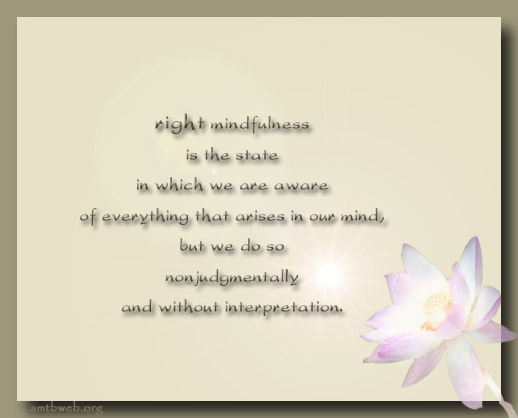
At the heart of Mindfulness Training is giving space for the anxiety to be. We are able to stand back out of the struggle as if we are the spectators of a boxing match. We watch the fight but we are not part of it being punched up by the thoughts and feelings. Mindfulness is about breathing into the anxiety and giving it space, naming it, watching it like some creature from out of space but never giving in to it.
If we try to run form our anxiety we will exhaust ourselves like the man running from the wind. The old Master was right. Sit still, breathe, observe and it will pass you by.
Once a young monk fell asleep in the Meditation Hall while the monks were chanting the Buddha Name. The monks had been there in the hall since the early hours of the morning with the chant of the word “Amitofuo” resounding through the temple. Unceasing, the chant continued into the late afternoon.
When the Master noticed a young monk asleep he asked him: “Why are you sleeping during the chanting, my son?” “Master, I do not see the purpose. I have chanted and chanted and nothing has changed. Maybe I am not suited to this practice.” “Then come with me replied the Master.” The kindly Master led the young novice to his room. “Bring me your water glass”, demanded the Master. The novice went inside his room and returned with his glass full of water. The Master took the glass and went to his office. Taking a calligraphy brush he rolled it with some water into the ink stone then dipped the brush into the young monk’s glass of water. Suddenly there were swirls of black in the clear water. The young monk stood transfixed as the clear water turned completely black.
“Now, my son, remove the ink without tipping out or refilling the glass. If you can do this then you will have wisdom of the dharma.”
The young monk seemed to fumble for words now wishing he had not fallen asleep during the chanting and wondering what punishment the Master was going to mete out. “But Venerable Master I cannot do this.” “Good reply”, came the Master. Then the old Venerable took the novice back outside to a place just under the eaves of the tiled roof of the monks’ quarters. The old Venerable look up then down as if to be positioning the glass. Then with deliberate precision he placed the glass full of inky black water on walk way. “There, my son. Sit here and contemplate and meditate on the glass until I tell you to move.” The young monk did just as the Venerable had asked him.
One hour passed . . . then two. . . then three. The young monk focused with concentration on the glass of inky water contemplating how he could remove the dark water without tipping it out. While doing so large dark rain clouds began to amass overhead. There were distant rumblings of thunder. Soon small droplets of rain began to fall then a deluge broke loose. Rain began to fall in torrents upon the tiled roof sending streams into the spouting. Before long droplets of rain water began to fall into the glass precisely where the Master had positioned it. Droplet after droplet after droplet the drops fell into the glass. Soon the glass was full to the brim and began to over flow with the inky water gradually being displaced. Each raindrop sounded like the “tock” of the ‘muyu’ – the wooden fish the monks strike in time with the chanting. The young monk watched with glee as gradually the inky water was displaced by the droplets of cool clear rain water.
Eventually the rain stopped. The young monk sensed the presence of the Master and looked up at him with a glowing smile. The Venerable smiled in turn knowing that enlightenment had come upon the novice. “The rain removed the inky water, Master” came the novice. “And removed the ignorance from your mind as well” returned the Master.
We often turn our back on these types of issues….UNTIL…they effect us!
Maybe it’s time to pay more attention because situations like this are happening all around us, in every country, and, it is effecting us in one way or another!
Please, please watch all of this video..it’s worth it and it may bring tears to your eyes at what these companies and governments are doing to OUR Mother Earth!
“Do not pursue the past.
Do not lose yourself in the future.
The past no longer is.
The future has not yet come.
Looking deeply at life as it is
in the very here and now,
the practitioner dwells
in stability and freedom.
We must be diligent today.
To wait till tomorrow is too late.
Death comes unexpectedly.
How can we bargain with it?
The sage calls a person who
dwells in mindfulness
night and day ‘the one who knows
the better way to live alone.”
Interesting article from a blogging friends of mine silentwindsofchange.wordpress.com , I do hope you agree?
You are always connected to your higherself, but in noticing it you gain more of a benefit.
Two voices in your head happen that sound like you are talking to yourself. One voice always is negative and talks you down. That is your ego. The other always is positive and gives you instant brilliant answers when you have questions. The trick is listening completely to that positive one’s guidance and laughing at the negative one.
In doing this two things will happen.
One, as you listen to your higherself your life will get better. You will hear more from your higherself as you show it you are interested in what it has to say. Don’t be surprised if you start getting energetic excitement from your higherself as you give it more attention. This is usually felt as a chill or energy rush that starts at the top of your head and runs through your body and out your feet. You will at one point get to a level where you can ask questions and instantly get answers that are amazing and at a level higher than you would expect from yourself. After some amount of time doing this you will have a calm wash over you that is your new normal level of calm. Many calmer levels will occur after this as you progress. One day you will be calm and peaceful like Eckhart Tolle and Mooji.
Two, as you laugh at your Ego and pay no attention to it’s negative comments something else profound will happen. It will want to play again. Let it know that it can only play if it will support you in all ways. I know this sounds crazy but I can assure you it will work if you stick with the plan. It wants a job. It wants to help you. How do you talk to it? Talk to it out loud when you are by yourself. Through this and many lifetimes it did what it did to keep you safe. Those days are now past and it needs to learn the new rules which you are teaching it by forcing it to play nice. Ego has an ego and if you embarass it by laughing when it is negative it will change it’s ways and only give you reassurance and assistence. Your higherself assists also with this process.
So there you have what has worked for me in my life. Will it work for you? I have no idea but what do you have to lose? The way those two parts of you are working now is not benefitting you. You do know at least one person who this has worked for so why not give it a try?
Imagine yourself enclosed by a small space within traditional Japanese screens. In complete silence and isolation you examine in minute detail your entire life, especially important relationships like mother, father and siblings within the boundaries of the three strategic Naikan questions. Gradually over seven days of silence and deep introspection interrupted only by the Naikan therapist entering your space, bowing giving you food and drink and asking the three questions to the portion of your life you have been examining, piece by steady piece the meditator dismantles the ego that have hovered like dark clouds blocking the blue sky. Like awakening from a dream the meditator opens his/her eyes to the light of day. This is Naikan.
Naikan( From the Japanese Nai = Inner Kan= looking) is a therapy developed in Japan by Yoshimoto Ishin (1916 -1988). It was adapted from a Jodo Shinshu Buddhist practice of a meditation of deep introspection and self examination. Although the basic structure remains the same it has been further developed to be used in modern therapeutic settings.
There is emerging a palpable curiosity towards the Eastern and Buddhist psychology. With the emergence of the now evidenced based “Mindfulness” therapies (Acceptance and Commitment Therapy, Mindfulness Based Cognitive Therapies etc) Naikan stands to be re-examined with energetic curiosity.
I must add a note of caution here. It is easy to confine the Mindfulness based therapies, of which Naikan belongs, to the therapist’s clinic. This would be a huge mistake. Naikan is essentially a way of life for everyone who wishes to live a more fulfilling and happy life.
Naikan is essentially a method of deep introspection. It is a way of examining one’s life from a different angle by asking strategic questions and arriving at a deep appreciation of life the way it is. The big mistake most people make with Mindfulness based processes is to expect the process to eliminate life’s problems. This is not the aim. After all, none of us are immune from life’s struggles or to put it in plain language: “shit happens”. What Naikan does is to help us look at life’s sufferings from a different angle – one of deep gratitude. It does this by radically placing us in front of our self-centeredness. When we do this a new energy begins to flow and we become better equipped to face life’s issues.
Naikan does this by asking three strategic questions:
What have I received from person (or event) x?
What have I given to person (or event) x?
What troubles and difficulties have I caused to person (or event) x?
In Naikan we examine our entire life in minute detail from the time we were born to the present moment. We focus primarily or relationships rather than events as we are formed by our early childhood relationships and relationships in general. It is a Naikan principle that our mental health is based almost entirely upon how we relate with one another and our environment.
In Classical Naikan the client spends an intense seven day period in meditation on one’s entire life guided at regular intervals by the Naikan therapist. There are shorter versions of this process to suit the client’s schedule. It is often said that one of the “down sides” of Naikan is its intense seven day meditation. However, we must ask ourselves, what is seven days in what often has been a lifetime of struggle with certain issues?
Ideally Naikan is done with a “Naikan Guide” or therapist. However it can also be performed by oneself on a regular basis.
Gratitude in Naikan
The concept of “gratitude” plays a crucial part in Naikan. In Chinese the word for gratitude is “gan ji gan en”. The English word “gratitude” does not do justice to the Chinese words which convey a different concept. In our daily speech we can say we are “thankful” for something but still inwardly hold resentment or grudges. I can say “thank you” to someone for something even if that someone has annoyed me greatly. I do it out of politeness. The Gratitude in Naikan goes far beyond the concept of thankfulness. It is a realization of the “gift” of life and a sense of deep contentment with the way things “are”. . . an acceptance of the “is-ness” in all things. When we have this sense of deep gratitude we are free. Many say after Naikan they experience a feeling like a ton of bricks lifted off their shoulders. This is a happiness which goes beyond what “happens” to us.
Personal Responsibility
Naikan is a therapy and process that places responsibility squarely upon the individual challenged with their issues. Throughout the Naikan process the therapist will not give “advice” but guide the client to take responsibility for their own healing. In this process there is tremendous empowerment.
Much more
There is much more to Naikan than these few words can give justice to. Like all Mindfulness studies – they need to be experienced rather than didactically analyzed.
Because of my all embracing hearing my name Kuan Yin is known everywhere. Since I myself do not meditate on sound but on the meditator. I cause all suffering beings to look into the sound of their voices to obtain liberation. Surangama Sutra
Two of the greatest tragedies which face us on a global proportion as we turn into this next millennium are poverty and human mass slaughter.
The poverty of which I speak is not the material poverty which we are so used to hearing about. It is another kind of poverty, far, far worse and more destructive to the fabric of society than economic poverty. This is the poverty of isolation and loneliness.
It is a kind of poverty which is extremely insidious and continues to increase and underscore our family life and social order. The symptoms of this social sickness are many – broken relationships and divorce, crime, emotional and physical violence, war between communities, mental illness, and addictions; it is a poverty which strips millions of self-esteem. A person is left dry of any value or worth and is rendered powerless.
The tragedy is that although we live in densely populated cities and chat over countless cups of tea and coffee, the sense of isolation is ever increasing within our communities, within our work places, within our schools and even within our churches.
The second great tragedy is that we have witnessed more human carnage this last century in war and murder than in any other time of world history. This is due in part to the greater destructive potential of modern weapons. In early days of world history one spear may have killed one person in war. Now one missile has the capability of destroying a whole nation.
It thoroughly astounds me that with all our sophisticated technology the world has not advanced very far at all in terms of peace and the sanctity of human life. We are able to send a space probe to the outermost limits of our universe, but we are thoroughly unable (or unwilling) to work toward a peaceful society.
I would boldly suggest that the reason for this is that we are building societies with the predisposition to instant self-gratification. We seek personal power and material possessions and we want it right now. War is a multi million-dollar business and it grants personal empowerment – for the winners that is. Peace on the other hand requires community effort and its fruits though plentiful, even financially, are not seen immediately. You can’t make a quick buck on peace.
Our love affair with technology has enhanced our need for instant self-gratification. The Internet enables us to connect instantly with others at the opposite end of the globe. We can have cyber-relationships, even cyber-sex. The iPod has fast become the ‘mePod’ as millions of people absorb themselves within their invisible cone of silence. Here is the real danger. We are drawn into the illusion of being part of a ‘global community’. This is nothing more than a fraud. Hugh Mackay, Australian Psychologist and social commentator observes in his book Why Don’t People Listen? :”When the emphasis is on information transfer rather than relationships, the life of the (global) village becomes meaningless: shared data is no substitute for the sense of shared identity and mutual obligation which come from shared experience.” People are beginning now to isolate themselves from real community. The result will be an ever-increasing sense of isolation.
Listening is a communication experience which has within it the power to break the grip of isolation and to plant and nurture a new community. Listening shared from the level of the human heart. No other communication technology is able to do this.
Several years ago I began to notice the importance of Empathy and how deep listening (listening with the intent to understand) can affect individuals and be the catalyst for positive change both personally and as a community. As a society we have forgotten how to listen. This has been gravely injurious to our corporate journey as a society as well as to our personal growth and well-being. We have lost our prophetic foundations, as when we don’t listen we miss vital information. Listening and vision go hand in hand. When we don’t listen we don’t see the problem ahead – we fail to see the big picture sand we move blindly into the future.
I have observed what ‘real’ Listening can do. I have seen it heal people, turn enemies into friends, I have seen it change people – dramatically, and I have seen it close sales deals worth millions of dollars where no other ‘strategy’ had worked. It is powerful beyond all measure.
In speaking to many people about their recovery from difficult circumstances or emotional illness, I have heard people talk about that thing which really made the difference to them – the turning point, if you like – was that some one took the time to really listen to them. This intrigued me as this phrase kept coming up time and time again: “really listened”. What was it in this act of “really listening’ which was able to turn a person’s life around?
But we don’t have time any more. We have systems to attend to, reports to write, deadlines to meet, meetings to go to. Furthermore, the things we listen to is mainly information shuffling as this is what our technology has taught us to do. Emails are quick and precise. Text messaging is even briefer couched in texting language for rapid application. We are fast becoming shallow beings forgetting how to plummet the depth of our souls. Information has become our God.
I will never forget the words of a potential client when I was young and green who once said to me “I don’t care what you know. I just want to know that you care. You listened to me. That is enough and that is all.”
After my post re two blogging award nominations from Hari and Michelle that i posted yesterday, today I received another one from my dear friend Mike, AKA Q-Bird http://quarksire.wordpress.com/about/ this one is the Best Moment Award.
I am once again humbled by Mike’s nomination and so appreciative of his support of my blog, however I will accept this nomination in the true spirit in which Q-Bird gave it to me, but gracefully decline to adhere to the nomination process due to the time it takes to complete.
I have received two blogging nominations for awards this week from two of my fellow bloggers and friends Hari at http://hariqhuang.wordpress.com and Michelle at http://lifeasagarden.wordpress.com . Please check out their blogs because they are both so full of inspiring, wonderful information and energy 🙂
I am as usual very humbled by their kind thoughts and nominations and so appreciative of their support of my blog, however I will accept their nominations in the true spirit they were bestowed on me but gracefully decline to adhere to the nomination process due to the time it takes to complete.
Thank you dear friends, from the bottom of my heart.
Several centuries ago, seven monks were in a cave in a jungle somewhere in Asia, meditating on unconditional love. There was the head monk, his brother and his best friend. The fourth was the head monk’s enemy: they just could not get a long. The fifth monk in the group was a very old monk, so advanced in years that he was expected to die at any time. The sixth monk was sick – so ill in fact that he too could die at any time. And the last monk, the seventh, was the useless monk. He always snored when he was supposed to be meditating; he couldn’t remember his chanting, and if he did he would chant off-key. He couldn’t even keep his robes on properly. But the others tolerated him and thanked him for teaching them patience.
One day a gang of bandits discovered the cave. It was so remote, so well hidden, that they wanted to take it over as their own base, so they decided to kill all the monks. The head monk, fortunately, was a very persuasive speaker. He managed – don’t ask me how – to persuade the gang of bandits to let all the monks go, except one, who would be killed as a warning to the other monks not to let anyone know the location of the cave. That was the best the head monk could do.
The head monk was left alone for a few minutes to make the awful decision of who should be sacrificed so that the others could go free.
When I tell this story in public, I pause here to ask my audience, “Well, who do you think the head monk chose?” It stops some of my audience from going to sleep during my talk, and it wakes up the others who are already asleep. I remind them that there was the head monk, the brother, the best friends, the enemy, the old monk and the sick monk (both close to death), and useless monk. Who do you think he chose?
Some then suggest the enemy….. “No”, I say.
“His brother?”
…….”Wrong.”
The useless monk always gets a mention – how uncharitable we are! Once I have had my bit of fun, I reveal the answer: ……The head monk was unable to choose.
His love for his brother was exactly the same, no more and no less, than his love for his best friend – which was exactly the same as his love for the enemy, for the old monk, the sick monk, and even for the dear old useless monk. He had perfected the meaning of those words: the door of my heart will always be open to you, whatever you do, whoever you are.
The door of the head monk’s heart was wide open to all, with unconditional, non-discriminating, free-flowing love. And most poignantly, his love for others was equal to his love for himself. The door of his heart was open to himself as well. That’s why he couldn’t choose between himself and others.
I remind any Christians in my audience that their books say to “love thy neighbour as thy self”. Not more than yourself and not less than yourself, but equal to yourself. It means to regard others as one would regard oneself, and oneself as one regards others.
Why is it that most in my audience thought that the head monk would choose himself to die? Why is it, in our culture, that we are always sacrificing ourselves for others and this is held to be good? Why is it that we are more demanding, critical and punishing of ourselves than of anyone else? It is for one and the same reason: we have not yet learned how to love ourselves. If you find it difficult to say to another “the door of my heart is open to you, whatever you do”, then that difficulty is trifling compared with the difficulty you will face in saying to yourself, “Me. The one I’ve been so close to for as long as I can remember. Myself. The door of my heart is open to me as well. All of me no matter what I have done. Come in.”
That’s what I mean by loving ourselves: it’s called forgiveness. It is stepping free from the prison of guilt; it is being at peace with oneself. And if you do find the courage to say those words to yourself, honestly, in the privacy of your inner world, then you will rise up, not down, to meet sublime love. One day, we all have to say to ourselves those words, or ones similar, with honesty, not playing games. When we do, it is as if a part of ourselves that had been rejected, living outside in the cold for so long, has now come home, we feel unified, whole, and free to be happy. Only when we love ourselves in such a way can we know what it means to really love another, no more and no less.
And please remember you do not have to be perfect, without fault, to give yourself such love. If you wait for perfection, it never arrives. We must open the door of our heart to ourselves, whatever we have done. Once inside, then we are perfect.
People often ask me what happened to those seven monks when the head monk told the bandits that he was unable to choose.
The story, as I heard it many years ago, didn’t say: it stopped where I have finished. But I know what happened next; I figured out what must have ensued. When the head monk explained to the bandits why he couldn’t choose between himself and another, and described the meaning of love and forgiveness as I have just done for you, then all the bandits were so impressed and inspired that not only did they let the monks live, but they became monks themselves…Well, that’s my ending anyway 🙂
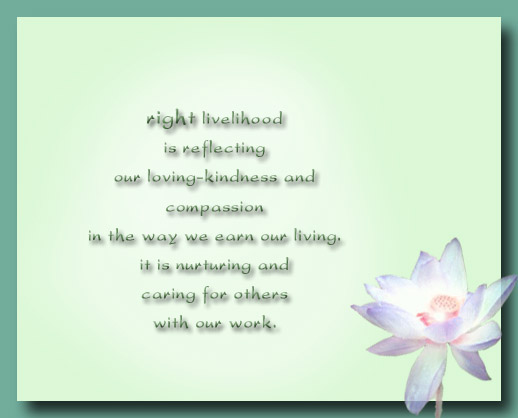
If only I could make a living out of Buddhism, or do I already?
When the Buddha walked the earth many asked him if he were a god. “No”, he replied. “Are you a spirit?” “No”, he replied. “I am Awakened.” Being awakened is the opposite of being asleep. When we are asleep we are in the world of dream and nightmare. One is strange and the other is frightening. Neither of which are real. That is the life that most live on a daily basis. It is a strange world because it rarely conforms to our hopes and desires. Frightening because we are living in fear of violence and losing what “happiness” we think we have. This is a very unsatisfactory way of living and creates huge problems for society. Depression is now one of the world’s major illnesses.
When we are awake we are alive. We are able to see life as a gift. Everyone likes a gift. I have watched many children at Christmas time receive gifts from their parents or relatives with huge smiles on their faces and lots of laughter and joy. Even when we try to be subdued with a:”Oh, really, you shouldn’t have done that” we nonetheless receive the gift with a smile on our face.
Rarely do we see life as a gift. We most often see it as a struggle and as a threat. We fight it – sometimes literally with great violence. We do not see it as a gift because we are asleep. When we are awake we are alive. When we live out our life as a gift to be given we are truly alive and living life to the fullest. That is how life is meant to be lived.
So many people are trying to make a living desiring to earn more and more in the fear that life will not have enough for them. They do not know the secret to true abundance. Abundance comes from our gift. This is the gift of life which is within each and everyone of us. When we find it we become livened and awake. When we find it the universe opens itself us to us.
The gift is within each of us. There is no need to criticize others for your unhappiness or lack of abundance when you already have it within you. It is only ignorance and ego that prevents you from discovering it as it hides under layers of masks.
Our Buddhist practice teaches us how to remove the masks of illusion. It teaches us to take responsibility for our own lives with a new set of skills for skillful living. Many think Buddhism is a religion. It is not. It is a life education that helps us up-skill to live effectively. When we sincerely apply the teaching methods we begin to see results in our life. This Cause and Effect. So why not change career path and make a new living?
The Buddha gave us a valuable teaching to dismantle the masks, wake up out of our sleep and live life. We can indeed make a wonderful living out of Buddhism.
Many people coming to test the waters of Buddhism for the first time often wonder where to start. There are literally hundreds of sutras with each school of Buddhism focusing on specific sutras that are at their foundation.
It is clear that Buddhism is about the issue of suffering and how to overcome it. Suffering takes on many forms from severe pain and illness and death to the petty annoyances that plague us on almost a daily basis. Buddhism teaches us to live a supremely happy and value centred life with the means to end the cycle of birth and death which is suffering.
The sutra of the Eight Awakenings is a very short sutra. In fact many Chinese monks used to learn this one by heart not only because of its brevity but also because it contained within it the essential of Buddhism.
I often call it the Mediators’ Sutra as it is a foundation sutra for all meditation work. It is well worth contemplating these Eight Awakenings carefully examining them in the light of your own life. I have included them here in their entirety.
Buddhist Disciples! At all times, day and night, sincerely recite and bear in mind these eight truths that cause great people to awaken.
The First Awakening:
The world is impermanent. Countries are perilous and fragile. The body is a source of pain, ultimately empty. The five skandhas are not the true self. Life and Death is nothing but a series of transformations—hallucinatory, unreal, uncontrollable. The intellect is a wellspring of turpitude, the body a breeding ground of offenses. Investigate and contemplate these truths. Gradually break free of death and rebirth.
The Second Awakening:
Too much desire brings pain. Death and rebirth are wearisome ordeals, originating from our thoughts of greed and lust. By lessening desires we can realize absolute truth and enjoy peace, freedom, and health in body and mind.
The Third Awakening:
Our minds are never satisfied or content with just enough. The more we obtain, the more we want. Thus we create offenses and perform evil deeds. Bodhisattvas don’t wish to make these mistakes. Instead, they choose to be content. They nurture the Way, living a quiet life in humble surroundings —their sole occupation, cultivating wisdom.
The Fourth Awakening:
Idleness and self-indulgence are the downfall of people. With unflagging vigor, great people break through their afflictions and baseness. They vanquish and defeat the four kinds of demons, and escape from the prison of the five skandhas.
The Fifth Awakening:
Stupidity and ignorance are the cause of death and rebirth. Bodhisattvas apply themselves and deeply appreciate study and erudition, constantly striving to expand their wisdom and refine their eloquence. Nothing brings them greater joy than teaching and transforming living beings.
The Sixth Awakening:
Suffering in poverty breeds deep resentment. Wealth unfairly distributed creates ill-will and conflict among people. Thus, Bodhisattvas practice giving. They treat friend and foe alike. They do not harbor grudges or despise amoral people.
The Seventh Awakening:
The five desires are a source of offenses and grief. Truly great people, laity included, are not blighted by worldly pleasures. Instead, they aspire to don the three-piece precept robe and the blessing bowl of monastic life. Their ultimate ambition is to leave the home life and to cultivate the Path with impeccable purity. Their virtuous qualities are lofty and sublime; their attitude towards all creatures, kind and compassionate.
The Eighth Awakening:
Like a blazing inferno, birth and death are plagued with suffering and affliction. Therefore, great people resolve to cultivate the Great Vehicle, to rescue all beings, to endure hardship on behalf of others, and to lead everyone to ultimate happiness.
These are the Eight Truths that all Buddhas, Bodhisattvas and great people awaken to. Once awakened, they even more energetically continue to cultivate the Path. Steeping themselves in kindness and compassion, they grow in wisdom. They sail the Dharma ship across to Nirvana’s shore, and then return on the sea of birth and death to rescue living beings. They use these Eight Truths to show the proper course for living beings, causing them to recognize the anguish of birth and death. They inspire all to forsake the five desires, and to cultivate their minds in the manner of Sages.
If Buddhist disciples recite this Sutra on the Eight Awakenings, and constantly ponder its meaning, they will certainly eradicate boundless offenses, advance towards Bodhi, and will quickly realize Proper Enlightenment. They will always be free of birth and death, and will abide in eternal bliss.
Pressing the Reset Button. A beautifully written article from a dear blogging friend of mine Sue Dreamwalker.
I do hope you enjoy it as much as I?
Namaste
Mark
Most if not all of us have a TV set, and most people switch on the News.. My own home is no different, but one of the reasons I do not like watching the news is because 99% of the time it only reports Negative News items. These do not get shown once or twice throughout the day, but many times in one news programme as it repeats it over and over , ingraining in us those negative thoughts, which in turn affects our own vibration.
We all fall victim to the pressures our lifestyles demand, as we see the world under population pressures, economical collapse and we all know that our natural resources are running out.
On the surface it would seem the World is falling apart, as yet more troubles are reported in Egypt and yet more peace talks are on the agenda.. Wars and conflicts everywhere we turn. We hear all the time about natural disasters causing havoc, and we are all commenting upon our various weird weather changes as ever increasing storms ravage parts of the world bringing destruction and tragedy.
Are you depressed yet? Have you switched off already from listening to me go on and on??
That’s why I reach for the remote and press the Off button to news, Not that I am not insensitive to the plight of the world, but because I choose not to dwell in the negative flow which bombards our homes hourly as we absorb and listen to the ever constant flow of tales of woe. When I know many Positives in fact far more are happening everywhere in every moment..
Every period in history when you look back has allowed us to alter our ways and change.. Many periods saw civil wars, plagues, world wars, and natural disasters on a scale that altered the weather patterns that brought about mini ice-ages .. Because we have achieved heights in technology does not mean we are super human beings immune to changes . Our world and the Universe runs in cycles, its constantly changing and so are we…
We are now nearly towards another end of a cycle during which our planets and our Earth change position in space . The Moon for example in its last cycle drew ever closer in orbit around us. Changes are also taking place in relationship to the Sun, as science is intent on watching what happens as solar flares erupt . All of which are having effects upon our planet which will ultimately lead to our weather and effect how we grow our own food, as places become dryer and others become wetter.
It’s not by chance in my opinion that the monetary collapsing of systems is also under threat. It doesn’t take a Rocket Scientist to understand that we cannot live on credit. And all these number crunching figures are generated by computer with no real monetary value behind them.. So would it really make a difference if the world debt slate was wiped clean? One has to ask oneself just where and who are reaping in the rewards of global finance, when countries and states collapse and go bankrupt.
We have based our modern day lives on competing with each other , Bigger Profits, Under cutting, We only think “ What’s in it for us”, “ What can we get out of it” We have to be Winners or Losers… But what happened to equality, or sharing? Why cannot the Haves give more to the have nots?
My feelings are that we are each of us through our various experiences being given opportunities to alter our set ways.
We can if we want, choose to Press the Reset Button of our lives
People are now seeing this way of living cannot carry on. People are standing up for the Freedom and rights.. Woman’s rights are at long last being addressed and exposed as the Feminine Energies are released again as more corruption and injustices are revealed.. The Male energies which have dominated are now fighting back for survival as the Feminine cycle is about to come into its own.
We are becoming more health conscious, people are beginning to adapt and alter their life styles instinctively wanting simpler lives as interest again is being shown in growing our own food. Even schools now are teaching infants and encouraging and embracing nature within their curriculum. We are at last beginning to see how important recycling is and conserving energy.
We each of us have an opportunity to look at our choices and ask ourselves some serious questions.
What effects are my choices having on the world?
I keep saying it, WE are not separate, thinking we are alone, what affects one, affects another.
We have to understand everything is connected to everything else. One TV programme I do like watching is BBC 2 ‘A Night with the Stars’ Back in one episode Physicist Brian Cox shows us a diamond and explained that when rubbed, it shifted the atoms within it into different energy levels. He said
“ Every Atom in the Universe shifts as the diamond heats up’ so in fact every time an atom’s energy level changes and that happens all the time. ALL the atoms in the Universe change energy levels.. We are all connected via the Universal Laws. Bringing home to us the law of Cause and Effect.
Interconnectivity Brian Cox.. Video just One and a Half minutes long folks!
What effect are our choices having, and how can we help heal the world?
Instead of those thoughts of “ What’s in it for me”, How about Resetting your thoughts to “ What can I contribute to it”. When we help someone else we help ourselves.
We all need to look at our life styles and we each have to take a deep look in the mirror.
Don’t wait for tomorrow or for someone else to change..
BE the Change
When we give out, so too do we receive.
The Indigenous Peoples have long known we are all one… They have long known how to balance within Nature. Now it’s time to once again Honour each other, We may not be able to change how another thinks or acts.. But it’s time to Honour ourselves and learn to Reset our own Lives to live less separately but more interconnectively as we bring our communities to be more caring and united in their common goals of sharing with each other to sustainable projects that help bring us together, not drive us apart.
If you can’t stand beside a friendless man
your meditation is nothing.
If you can’t listen to pain and terror then
your meditation is nothing.
If you can’t befriend the insane and share from their bowl
your meditation is nothing.
If you cannot take the gun gently from the hand of the murderer
and embrace him in his horror then your meditation is nothing.
If you cannot see the beauty and life in the one without limbs then
your meditation is nothing.
If you cannot sit beside the aged in their loneliness then
your meditation is nothing.
If you can’t embrace your own pain and shout “Yes!” to Life then
your meditation is nothing.
If you can surrender all that you are, all that you have,
if you can embrace life without wanting it or wanting to change it,
if you can hear the sounds of pain and joy and know they come from the same source,
if you can sit in the fire, rain, snow, sun and in surrender open your heart
to the purity of love then your meditation is the supreme gift of the Manu Pearl, the light of the Pure Land.
If you can meditate the Nothing knowing your meditation is nothing then
all serenity and bliss radiates like perfume from the Lotus.
Nothing and all are one in Joy.









 Endless Light and Love