Tao

All posts tagged Tao

My Home Alter, What does yours look like?

Published 15/09/2013 by inspiringyourspirit

Namaste My Friends,

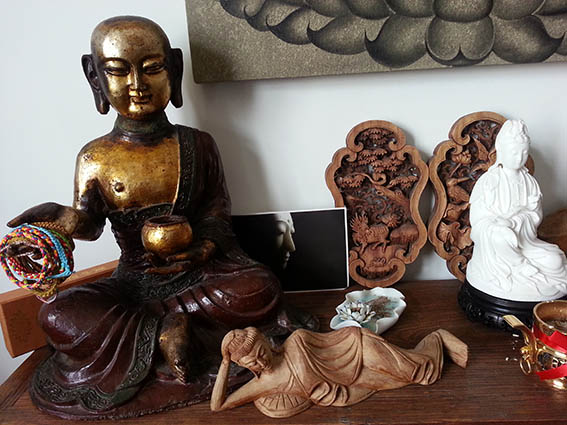
Here are some photos of my home alter, a place for me to sit, to think, to meditate, a place where I give my daily thanks for all I have in my life, where I pay my respects to my past family members, friends and spiritual guides.

I would love to hear your comments and to also see photos of your home alter, your peaceful place/s, let’s share the beauty and calm with all our friends and help raise the spiritual vibration between us all 🙂

Namaste
Mark

20130915_112446

buddha

buddha1

buddha2

1 Minute that might change your life.

Published 14/09/2013 by inspiringyourspirit


It’s Friday so lets Smile

Published 13/09/2013 by inspiringyourspirit

13 - 1-1

That+s+why+it+s+called+the+bitch+seat_49ef2f_4783837

13 - 1


maxine working from home space.compassion 13 - 1 (1)


Have a fantastic weekend my friends,Peace, Love and Happiness to you all.

Namaste _/\_

Mark

The Misguided Monk

Published 12/09/2013 by inspiringyourspirit


The importance of true friendship:

When an old hermit monk has his day interrupted by an uninvited guest, he is unwillingly taken on a journey to discover the true meaning of companionship.

I think we all have something to learn from this simple cartoon 🙂

Namaste

Mark

Life Standards

Published 12/09/2013 by inspiringyourspirit

mmexport1378953730217


Wise Words indeed: Forgiveness. Kindness. Honesty. Happiness. Goodness. Giving your Best.

Mother Theresa, what an outstanding woman, her life was completely selfless and her everyday was filled with giving of her love, her time and her wisdom to the sick, the poor and the street children of India. Mother Teresa said “By blood, I am Albanian. By citizenship, an Indian. By faith, I am a Catholic nun. As to my calling, I belong to the world. As to my heart, I belong entirely to the Heart of Jesus.

In April 1996, Mother Teresa fell and broke her collar bone. In August she suffered from malaria and failure of the left heart ventricle. She had heart surgery but it was clear that her health was declining. The Archbishop of Calcutta, Henry Sebastian D’Souza, said he ordered a priest to perform an exorcism on Mother Teresa with her permission when she was first hospitalised with cardiac problems because he thought she may be under attack by the devil. On 13 March 1997, she stepped down from the head of Missionaries of Charity. She died on 5 September 1997. At the time of her death, Mother Teresa’s Missionaries of Charity had over 4,000 sisters, and an associated brotherhood of 300 members, operating 610 missions in 123 countries.These included hospices and homes for people with HIV/AIDS, leprosy and tuberculosis, soup kitchens, children’s and family counselling programs, personal helpers, orphanages, and schools. The Missionaries of Charity were also aided by Co-Workers, who numbered over 1 million by the 1990s.

Mother Teresa lay in repose in St Thomas, Kolkata for one week prior to her funeral, in September 1997. She was granted a state funeral by the Indian government in gratitude for her services to the poor of all religions in India.Her death was mourned in both secular and religious communities. In tribute, Nawaz Sharif, the Prime Minister of Pakistan said that she was “a rare and unique individual who lived long for higher purposes. Her life-long devotion to the care of the poor, the sick, and the disadvantaged was one of the highest examples of service to our humanity.”The former U.N. Secretary-General Javier Pérez de Cuéllar said: “She is the United Nations. She is peace in the world.

Rest in Peace Mother Theresa and thank you for the gifts of love and compassion you gave to the world.

Namaste
Mark

Blogging Awards

Published 09/09/2013 by inspiringyourspirit

premios-liebster-awards

🙂 _/\_ to my dear friend Gina from http://ginandrea.wordpress.com/ for nominating me for the Spanish version of the Leibster Blogging Award. Here is what Gina wrote to me:-

Dear Mark,

Despite the language barrier, I just wanted to let you know that I just nominated you for the Liebster Award. I do understand this award is for beginners; however, I wanted to make sure other bloggers and readers had the amazing opportunity to see the world from your eyes, from the lenses of your camera, from your writings. My post has been written in Spanish. It is up to you, if you’d like to participate in such interesting exercise.

For more information, please visit: http://ginandrea.wordpress.com/2013/09/06/nominada-al-liebster-blog-award/. (There is always a chance to translate the page to the English language)! 🙂

Gina

As many of you know, i have received so many nominations for blogging awards and although I’m so pleased to receive them and humbled at the thought that you deem my blog as a worthy recipient of these wonderful awards, I usually accept the award in the spirit that it was intended but gracefully decline to take part in the acceptance criteria due to the time it takes to comply.

So, once again my friends and to Gina…THANK YOU from the bottom of my heart.

_/\_

Namaste

Mark

Stop the War Inside and see the Peace Outside

Published 04/09/2013 by inspiringyourspirit

WOW….This video is amazing, if it does not connect to your heart and bring tears to your eyes then…..!

Namaste
Mark

A Peace of Single Thought

Published 02/09/2013 by inspiringyourspirit

1001427_10201699892649491_949519468_n

“The peace of the world starts with a single thought. We can all think peace. The next step is to do peace. That is our gift to the world.”

“Our planet is perched on a precipice. We stand at a cross roads of history. Which way will we turn? There is serious conflict raging in many quarters of our world and even in our own cities and families. Peace begins with a single thought. If our mind is full of confusion and inner conflict we will see a world full of confusion and conflict. When are minds are clear and peaceful we see a beautiful and peaceful world. Our external world is a result of our very thoughts. We must deal with the conflict in our own minds not by elimination but by entering into a new relationship with our inner enemy. When we make peace with our minds we bring peace into our immediate outer environment. We are then ready to do peace.”

Namaste my friends

Mark

It’s My Anniversary Today

Published 01/09/2013 by inspiringyourspirit

anniversary-2x

Its a double celebration today.

Its my 1st Anniversary for this blog Endlesslightandlove.com 🙂

And its’ my eldest Son Matthews 27th Birthday

So, I give out my heart felt thanks to all my blogging friends for your follows, your comments and your continued support of my humble blog. May your day be filled with Love, Joy and Compassion.

and to my Son Matthew, my first born, may your day and your life be filled with Love, Joy and Pure Source Energy 🙂

Namaste _/\_

Much Metta
Mark

Let Go and Grow

Published 31/08/2013 by inspiringyourspirit

Let Go

We all do it!…Hold on to memories, good or bad, problems, issues, traumas, past experiences that tie us down and stop us from flying free, but why?

It happens to the best of us.

We do our best to be positive, to meditate, to be in the ‘Now’, in the ‘Moment’ we try to push away the past, forget about thinking of the future and live for today, for this special ‘moment’ in time that we are experiencing right here, right now.

But then it comes back to haunt us again, our ‘Ego’, testing us, bringing us to task and remembering to remind us of the past and to re-direct our thoughts to the future too…

I was again at this very point yesterday morning, questioning myself yet again, ‘Why Me, Why Now’..testing my inner self re my own spiritual journey, the pathway i’m on and the reasons why i’m walking this pathway of spiritual healing. Also questioning why I have been blessed (or is it cursed) with these gifts that have for some reason been bestowed on me!… So to gain some clarity and to help stop my Ego in its tracks I decided to meet with a Buddhist Monk friend of mine yesterday, we sat, meditated, shared our passions for humanity and talked about this and that, we shared stories, we laughed and we smiled, a lot 🙂 I opened my heart, I cried a lot especially regarding my own suffering for the suffering i see and feel from others, we discussed my journey and my mission. We prayed and shared the spiritual love and compassion of the Buddha and then it happened, as if by magic….A clearing of my mind, peace and Joy was once more back in my heart and in my mind.

My Ego was gone and I was in the ‘Now’ once again, I let myself…. ‘Just Be’…

Namaste my friends

May your weekend be filled with Love, with Joy and may your face be filled with the most wonderful Smile 🙂

love and blessing of pure positive energy
Mark

Traditional Native American Prayer

Published 30/08/2013 by inspiringyourspirit

533724_10201719199252144_924714420_n

Beautiful words of wisdom 🙂

Namaste
Mark

Seek Joy not Happiness

Published 28/08/2013 by inspiringyourspirit

1175620_562925190441997_825877051_n


Seek not happiness in life. Why settle for second best? Seek pure Joy. Happiness depends on what happens to you. Pure Joy has no limitations.


Joy is an abiding state. It has no conditions attached – no small print at the foot of the page. It is not dependent on status, race or creed. It comes not as a result of economic conditions or political policies. It is for all people of all times and all places.


That is what the Buddha came to show us. He observed and was deeply affected by the joylessness in life. Many, including fellow Buddhists, miss this point. It is often stated that the Buddha came to show us a way out of suffering. No! He came to show us Joy and that we may all directly experience this. But, I hear you say, isn’t this the same thing? Almost! Except it falls short of the mark. The former seems to be afraid of naming it. We are so entrenched in our suffering that we are often afraid to proclaim its antidote. We are like blind people stumbling across a jewel and then ending up in endless debate about what we have found.


Happiness depends on what happens to us; thus its name – “happen-ness”. Happiness so often depends on moods, feelings, ideas and even values. Joy, on the other hand, transcends all these things. Happiness is a brightly decorated spider that the poor insect mistakes for a beautiful flower. When the insect thinks it has attained this flower the spider then grasps the insect. It is unable to escape the sticky web and eventually its fate is sealed by the poisonous fangs of the spider.


The Buddha experienced these things in his life. He found an antidote, a path to untangle the web of ignorance and lead us to Joy.


Joy is like the air we breathe. It is vital and fresh, pure and enhancing. However, in ignorance we have built houses and palaces of happiness whose walls have blocked out the fresh air of Joy. We will soon perish of asphyxiation in this condition.


Joy is pure being. When we begin to pull down the walls of self-cherishing and attachment then we will be able to breathe the fresh air of Joy. It is this Joy that is limitless.


My wish for the world and for you my dearest friend is everlasting Joy. May you practice its path and share it with others on the journey.


Namaste

Mark

Butterflies of Peace

Published 23/08/2013 by inspiringyourspirit

18062010361

I first heard the story of the Peace Butterfly from a poor Chinese farming family near Tian Mu Shan in Zhejiang Province. The grandmother had heard it from a traditional Chinese Story Teller. It is not known if it is “true” but there is great “truth” in it. Wu said it was sad that the story was discontinued being passed on. He said it had great power. You will find this if you look carefully.

It is a story of Peace. It is not just a “pretty” story or “cute” or “sweet” story. It is a story of transformation. Look below the surface and see what you can find. It is my mission to keep it alive and from it give disadvantaged rural children an opportunity to education.

This story was told to me by a farmer who lives near the village of Shi Ta Wan near Zaoxi in China. He is not sure where the story comes from but he thinks it from Yunnan Province. He said it does not matter. He told me that the people often used to tell the story “to keep it alive.” He regrets that for a long time now the people have forgotten to tell it.

A long time ago there lived a hermit monk called San Qi. He lived in a hut beside a mountain stream. During his time there was much violence and war as local war lords tried to grasp power. There was much sadness and suffering and many families had lost not only their belongings but also family members who were killed in the wars.

San Qi was very sad. Daily he prayed that the Bodhisattva Kuan Yin would bring peace to the land.

One night he had a dream. In the dream Kuan Yin in all her beauty appeared to San Qi. She told him that a battle was to begin between two towns the following day. She instructed him to play his bamboo flute with all his skill beside the mountain stream. With that, she took the form of a butterfly and flew into the clouds.

The following day, San Qi, disturbed by the news of impending battle and astonished by the dream did as he was told in the dream. He sat on a rock beside the gentle mountain stream and began to play a soft melody on his flute. He played with great care and skill. The notes were like wisps of breeze as they floated melodiously about him. Suddenly there appeared a beautiful blue butterfly dancing about his head to the wooden tones of his flute. Then two appeared of different colours; then a third, then dozens then hundreds. Before long there were thousands upon thousands of exquisitely colourful butterflies. As San Qi continued to play the butterflies ascended towards the sky.

Down in the valley the armies and people of both cities were facing each other ready for the battle. The archers had drawn their bows with arrows posed for the kill. Suddenly there descended from the sky the thousands upon thousands of butterflies. There was such a host that the sun was darkened by their presence. Afraid that if they released their arrows the soldiers of both sides would kill the butterflies and afraid that this was a sign from the heavens they put down their weapons and felt great shame.

A young man who had been collecting Bamboo in the mountains above the village told the people he had heard a heavenly sound of flute coming from beside a stream. When he went to investigate he saw the monk San Qi playing his flute surrounded by a host of butterflies.

Before long the word had spread in the two towns. That very evening the people of the waring towns came together and lit candles and incense to the Buddha for showing them the way to peace and happiness.

It was decided that every year the villagers would tell the story of San Qi and remember the way of peace and happiness. People began to grow many coloured flowers to attract the butterflies and there was much happiness through the region.

This is the story of San Qi and the Peace butterflies.

Namaste
Mark

Transforming Panic Into Peace: 3 Steps to Relieve Anxiety

Published 21/08/2013 by inspiringyourspirit

Meditating1

By Alex Keats

“No matter how hard the past, you can always begin again.” ~Buddha

Growing up, I was one of those people much more concerned about what you thought of me than what I thought of me.

With my focus being on how I was being perceived by those around me, it left me feeling extremely unsettled.

I was desperate to be liked and accepted.

“Be who you are and say what you feel, because those who mind don’t matter and those who matter don’t mind” was a nice idea for the fortunate, but certainly not for me.

I was convinced that Dr. Seuss was living in fantasyland!

This social anxiety spread to my work life, too. I wondered why I was never truly happy or successful. I wondered why I didn’t enjoy the rich relationships that so many around me seemed to enjoy.

Then I discovered Zen.

I read that Zen means awareness, and being with what is, as it is.

What I loved most about Zen is its utter simplicity in recognizing what is really true. Not what is partially or sometimes true, but what’s always true.

It didn’t compromise.

I liked that. I wanted that ability to recognize what was always true. That sounded like real emotional freedom to me.

Zen kept telling me truth was simple, so simple that it was often overlooked by the mind that loved to judge, condemn, compare, and resist.

Zen meant to be in alignment with reality as it actually unfolded, not as I wished it would unfold.

Simple indeed!

I saw how my mind loved to complicate things. I saw how my mind resisted so much of what was actually happening.

And I was miserable and stressed out.

I failed to see the inseparable connection between panic and peace—and how resisting one would never reveal the other.

However, as I began to incorporate what I was learning, I found that when I met the anxiety symptoms without running from or avoiding them, my experience began to change, too.

They no longer had control of me.

I had new life.

And I wanted more of it.

Here are the 3 things that dramatically reduced or eliminated the anxiety and panic I had been experiencing. Consider implementing the following and see if it brings you more peace.

1. Meet your panic and anxiety head on.

Zen is essentially about who we’re being in relation to something or someone, and this includes needless anxiety. It also includes this very moment. In fact, especially this very moment, as it shows up, and not as I wish it would show up.

Inherent in anxiety and panic attacks is the belief that it shouldn’t be happening. But this is never true.

No amount of wishing a particular moment to be different than it is can ever change that moment. Many actually think it’s a good strategy, but it rarely ever works out.

Upon closer examination, I saw that whenever I ran from anything, that thing chased me. This included thoughts and feelings.

I found that whenever I faced and embraced anything, it eventually dissolved and left my experience. I was encouraged because I knew I was onto something significant.

I walked around with a new mantra: “What I run from must chase me.”

It served as a great reminder and often snapped me back into being in alignment with what was actually occurring.

Whatever I met head on lost its power, every time. Resistance would often magically drop away. And it was palpable.

I learned that I can either live with the laws that govern me (and all of life) or I can resist them and suffer.

Seeing that I couldn’t escape the consequences of how I met anything, I began to face what was facing me. And that insight, I found, was the difference between living a life of peace versus a living a life of stress.

I began to consciously choose peace.

In fact, any challenging situation (or emotion) that arose wanted to be met by my loving attention.

Stress manifested only if I avoided the negative thoughts and feelings.

If I shined the light of gentle awareness on what wasn’t at peace within me, it had to come out of hiding and release me—because I met it.

2. Allow it to be as it is.

Notice how your mind in its infinite wisdom will tell you that any particular thought, feeling, or experience should or could be different than it presently is.

Is it ever true? Can it ever be true? As much as the mind will try to use logic and reason, it’s never true.

Things are often different than they were, but they are never different than they are!

This may seem counterintuitive, but the reality is we must first accept our present lot if we wish to experience something different in the next moment. We can’t expect to resist our current situation and simultaneously be at peace.

It won’t happen.

The essence of Zen is about being with whatever arises without offering any resistance whatsoever. It’s about being neutral emotionally so that we are in a position to respond appropriately.

Alternatively, resistance is the energy that gives life to what we don’t want.

If we simply allow our symptoms of anxiety to be as they are, we find that they don’t hang around long enough to torture us.

By taking the backward step (as they say in Zen) into this present moment, we discover that peace never left us in the first place.

It just seemed that way.

Allow your anxiety to be as it is, as you look to overcome it.

3. Be compassionate with yourself.

Sure, you’ve heard it before. Be nice to yourself! Get off your back! Stop blaming yourself! The key to effective transformation—turning panic into peace—is to stop beating yourself up and to make yourself the most important person in your life.

Wouldn’t you treat someone who really needed support with kindness and compassion?

Why are you any different?

Perhaps the greatest quality of spirit that the Buddha spoke most about was compassion, not only towards oneself, but to others as well. Compassion is the great neutralizer that has a way of dissolving old wounds, as well as new ones.

The truth is you’re not to blame for your anxiety, but that doesn’t mean you aren’t responsible for it.

You aren’t “crazy” or “weak”—and you’re no less worthy a human being for experiencing it, either. Your mind may tell you different, and even sound very convincing, but is it really true?

No, it isn’t. Not even a little bit.

Work with yourself, not against yourself, if you truly desire to transform your panic into peace. It’s all in how you relate to your current condition. Self-condemnation only gets you more of what you don’t want.

The truth is, you are much more than any thought or feeling that arises. Within you is the power to transform your panic into peace.

As the Buddha said, “Be a light unto yourself.”

Transcending anything never involves rejection, but it always involves acceptance.

About Alex Keats

Alex Keats suffered from extreme anxiety for over five years and now helps people overcome it in all its forms. He is the author of “Born To Be Happy” and “The Dance of Imperfection.” To learn why you stay anxious, and to find out what mistakes to avoid, visit http://www.cure-anxiety-now.com.

Running from the Wind

Published 20/08/2013 by inspiringyourspirit

images-1

Running from the Wind

Once upon a time in old China a Buddhist Master caught sight of a man running down the road with all his might. He looked exhausted and frantic. “What are you running from?” inquired the Master. “I am running from the wind”, exclaimed the man. “Oh, there is nothing to fear then. Just sit still and it will pass you by”, returned the master. This is a simple enough parable but speaks deeply of Mindfulness and anxiety.

We often spend a huge amount of time and energy running from things. In fact it is a huge problem for society and is in endemic proportion. In our attempts to out run our fear, painful thoughts and feelings, loneliness and unhappiness our methods only end up creating far more suffering. Addictions provide an obvious example. In the attempt to avoid boredom, pain, loneliness, anger and sadness the addict only gets himself into more despair in the long term. As a result of his behaviour he creates guilt, isolation which creates even more loneliness, financial loss which creates even more despair. It is a vicious cycle. We don’t need to be the stereotypic addict to be in this cycle.

Anxiety disorder is another example. It is not the anxiety which creates anxiety disorder. After all, anxiety is a normal emotion which we all experience. At the core of anxiety is avoidance – a life of trying to avoid or get rid of anxiety which in turn creates even more anxiety. This is at the core of a panic attack.

In Mindfulness Training we learn to accept and even give space to unpleasant or painful emotions or thoughts. Mindfulness Training teaches us to accept them for what they are – just thoughts. This is not the same as avoiding or even tolerating unpleasant thoughts. Even tolerating can create a struggle. Many therapies aim at symptom reduction or eradication. The problem here is that we will always be “checking” to see is the symptom is going or gone thus creating what we are trying to get rid of – the anxiety!

At the heart of Mindfulness Training is giving space for the anxiety to be. We are able to stand back out of the struggle as if we are the spectators of a boxing match. We watch the fight but we are not part of it being punched up by the thoughts and feelings. Mindfulness is about breathing into the anxiety and giving it space, naming it, watching it like some creature from out of space but never giving in to it.

If we try to run form our anxiety we will exhaust ourselves like the man running from the wind. The old Master was right. Sit still, breathe, observe and it will pass you by.

Namaste
Mark

Buddhist Chanting and Rain Drops

Published 18/08/2013 by inspiringyourspirit

images

Once a young monk fell asleep in the Meditation Hall while the monks were chanting the Buddha Name. The monks had been there in the hall since the early hours of the morning with the chant of the word “Amitofuo” resounding through the temple. Unceasing, the chant continued into the late afternoon.

When the Master noticed a young monk asleep he asked him: “Why are you sleeping during the chanting, my son?” “Master, I do not see the purpose. I have chanted and chanted and nothing has changed. Maybe I am not suited to this practice.” “Then come with me replied the Master.” The kindly Master led the young novice to his room. “Bring me your water glass”, demanded the Master. The novice went inside his room and returned with his glass full of water. The Master took the glass and went to his office. Taking a calligraphy brush he rolled it with some water into the ink stone then dipped the brush into the young monk’s glass of water. Suddenly there were swirls of black in the clear water. The young monk stood transfixed as the clear water turned completely black.
“Now, my son, remove the ink without tipping out or refilling the glass. If you can do this then you will have wisdom of the dharma.”

The young monk seemed to fumble for words now wishing he had not fallen asleep during the chanting and wondering what punishment the Master was going to mete out. “But Venerable Master I cannot do this.” “Good reply”, came the Master. Then the old Venerable took the novice back outside to a place just under the eaves of the tiled roof of the monks’ quarters. The old Venerable look up then down as if to be positioning the glass. Then with deliberate precision he placed the glass full of inky black water on walk way. “There, my son. Sit here and contemplate and meditate on the glass until I tell you to move.” The young monk did just as the Venerable had asked him.

One hour passed . . . then two. . . then three. The young monk focused with concentration on the glass of inky water contemplating how he could remove the dark water without tipping it out. While doing so large dark rain clouds began to amass overhead. There were distant rumblings of thunder. Soon small droplets of rain began to fall then a deluge broke loose. Rain began to fall in torrents upon the tiled roof sending streams into the spouting. Before long droplets of rain water began to fall into the glass precisely where the Master had positioned it. Droplet after droplet after droplet the drops fell into the glass. Soon the glass was full to the brim and began to over flow with the inky water gradually being displaced. Each raindrop sounded like the “tock” of the ‘muyu’ – the wooden fish the monks strike in time with the chanting. The young monk watched with glee as gradually the inky water was displaced by the droplets of cool clear rain water.

Eventually the rain stopped. The young monk sensed the presence of the Master and looked up at him with a glowing smile. The Venerable smiled in turn knowing that enlightenment had come upon the novice. “The rain removed the inky water, Master” came the novice. “And removed the ignorance from your mind as well” returned the Master.

Namaste
Mark

Molokai Mom on a Mission

Published 16/08/2013 by inspiringyourspirit

We often turn our back on these types of issues….UNTIL…they effect us!

Maybe it’s time to pay more attention because situations like this are happening all around us, in every country, and, it is effecting us in one way or another!

Please, please watch all of this video..it’s worth it and it may bring tears to your eyes at what these companies and governments are doing to OUR Mother Earth!

Namaste
Mark

Live in Mindfulness

Published 15/08/2013 by inspiringyourspirit

22-3

“Do not pursue the past.
Do not lose yourself in the future.
The past no longer is.
The future has not yet come.
Looking deeply at life as it is
in the very here and now,
the practitioner dwells
in stability and freedom.
We must be diligent today.
To wait till tomorrow is too late.
Death comes unexpectedly.
How can we bargain with it?
The sage calls a person who
dwells in mindfulness
night and day ‘the one who knows
the better way to live alone.”

The Buddha

Namaste
Mark

Your Higher Self and Your Ego

Published 14/08/2013 by inspiringyourspirit

higher-self-connection

Interesting article from a blogging friends of mine silentwindsofchange.wordpress.com , I do hope you agree?

You are always connected to your higherself, but in noticing it you gain more of a benefit.

Two voices in your head happen that sound like you are talking to yourself. One voice always is negative and talks you down. That is your ego. The other always is positive and gives you instant brilliant answers when you have questions. The trick is listening completely to that positive one’s guidance and laughing at the negative one.

In doing this two things will happen.

One, as you listen to your higherself your life will get better. You will hear more from your higherself as you show it you are interested in what it has to say. Don’t be surprised if you start getting energetic excitement from your higherself as you give it more attention. This is usually felt as a chill or energy rush that starts at the top of your head and runs through your body and out your feet. You will at one point get to a level where you can ask questions and instantly get answers that are amazing and at a level higher than you would expect from yourself. After some amount of time doing this you will have a calm wash over you that is your new normal level of calm. Many calmer levels will occur after this as you progress. One day you will be calm and peaceful like Eckhart Tolle and Mooji.

Two, as you laugh at your Ego and pay no attention to it’s negative comments something else profound will happen. It will want to play again. Let it know that it can only play if it will support you in all ways. I know this sounds crazy but I can assure you it will work if you stick with the plan. It wants a job. It wants to help you. How do you talk to it? Talk to it out loud when you are by yourself. Through this and many lifetimes it did what it did to keep you safe. Those days are now past and it needs to learn the new rules which you are teaching it by forcing it to play nice. Ego has an ego and if you embarass it by laughing when it is negative it will change it’s ways and only give you reassurance and assistence. Your higherself assists also with this process.

So there you have what has worked for me in my life. Will it work for you? I have no idea but what do you have to lose? The way those two parts of you are working now is not benefitting you. You do know at least one person who this has worked for so why not give it a try?

Namaste
Mark

Naikan

Published 12/08/2013 by inspiringyourspirit

mindfulness-1


Imagine yourself enclosed by a small space within traditional Japanese screens. In complete silence and isolation you examine in minute detail your entire life, especially important relationships like mother, father and siblings within the boundaries of the three strategic Naikan questions. Gradually over seven days of silence and deep introspection interrupted only by the Naikan therapist entering your space, bowing giving you food and drink and asking the three questions to the portion of your life you have been examining, piece by steady piece the meditator dismantles the ego that have hovered like dark clouds blocking the blue sky. Like awakening from a dream the meditator opens his/her eyes to the light of day. This is Naikan.

Naikan( From the Japanese Nai = Inner Kan= looking) is a therapy developed in Japan by Yoshimoto Ishin (1916 -1988). It was adapted from a Jodo Shinshu Buddhist practice of a meditation of deep introspection and self examination. Although the basic structure remains the same it has been further developed to be used in modern therapeutic settings.

There is emerging a palpable curiosity towards the Eastern and Buddhist psychology. With the emergence of the now evidenced based “Mindfulness” therapies (Acceptance and Commitment Therapy, Mindfulness Based Cognitive Therapies etc) Naikan stands to be re-examined with energetic curiosity.

I must add a note of caution here. It is easy to confine the Mindfulness based therapies, of which Naikan belongs, to the therapist’s clinic. This would be a huge mistake. Naikan is essentially a way of life for everyone who wishes to live a more fulfilling and happy life.

Naikan is essentially a method of deep introspection. It is a way of examining one’s life from a different angle by asking strategic questions and arriving at a deep appreciation of life the way it is. The big mistake most people make with Mindfulness based processes is to expect the process to eliminate life’s problems. This is not the aim. After all, none of us are immune from life’s struggles or to put it in plain language: “shit happens”. What Naikan does is to help us look at life’s sufferings from a different angle – one of deep gratitude. It does this by radically placing us in front of our self-centeredness. When we do this a new energy begins to flow and we become better equipped to face life’s issues.


Naikan does this by asking three strategic questions:


 What have I received from person (or event) x?

 What have I given to person (or event) x?

 What troubles and difficulties have I caused to person (or event) x?


In Naikan we examine our entire life in minute detail from the time we were born to the present moment. We focus primarily or relationships rather than events as we are formed by our early childhood relationships and relationships in general. It is a Naikan principle that our mental health is based almost entirely upon how we relate with one another and our environment.


In Classical Naikan the client spends an intense seven day period in meditation on one’s entire life guided at regular intervals by the Naikan therapist. There are shorter versions of this process to suit the client’s schedule. It is often said that one of the “down sides” of Naikan is its intense seven day meditation. However, we must ask ourselves, what is seven days in what often has been a lifetime of struggle with certain issues?

Ideally Naikan is done with a “Naikan Guide” or therapist. However it can also be performed by oneself on a regular basis.

Gratitude in Naikan

The concept of “gratitude” plays a crucial part in Naikan. In Chinese the word for gratitude is “gan ji gan en”. The English word “gratitude” does not do justice to the Chinese words which convey a different concept. In our daily speech we can say we are “thankful” for something but still inwardly hold resentment or grudges. I can say “thank you” to someone for something even if that someone has annoyed me greatly. I do it out of politeness. The Gratitude in Naikan goes far beyond the concept of thankfulness. It is a realization of the “gift” of life and a sense of deep contentment with the way things “are”. . . an acceptance of the “is-ness” in all things. When we have this sense of deep gratitude we are free. Many say after Naikan they experience a feeling like a ton of bricks lifted off their shoulders. This is a happiness which goes beyond what “happens” to us.

Personal Responsibility

Naikan is a therapy and process that places responsibility squarely upon the individual challenged with their issues. Throughout the Naikan process the therapist will not give “advice” but guide the client to take responsibility for their own healing. In this process there is tremendous empowerment.


Much more

There is much more to Naikan than these few words can give justice to. Like all Mindfulness studies – they need to be experienced rather than didactically analyzed.