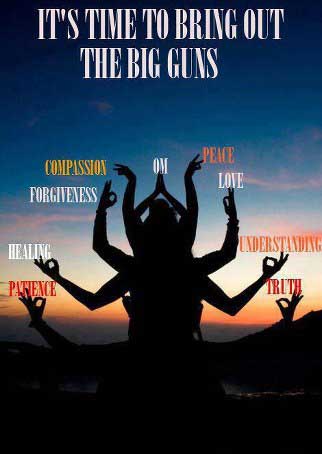
If we are to start making any headway towards changing our world for the better, to bring about peace, to eradicate disease and to bring about an end to poverty and starvation for millions of our brothers and sisters around the world, we will need to bring out the ‘Big Guns’
We need to start listening to each other, start to understand the other side of the story, give our compassion to others irrespective of their colour, religion or social status, forgive and forget what has gone on in the past and forge forward together as one humanity in the search of peace and in love of each other toward a common goal of life and environmental sustainability of our crops and waters and the protection of our planet, we need to build up our patience and understanding of other cultures and ways of life and most of all we need to be truthful and honest with each other.
To be happy with yourself, to be at peace with yourself, your looks, your life and the life around you is sometimes difficult to achieve but you can do it, you can be at peace with yourself, you can be stress free and enjoy your life to the full, all it takes is to firstly make a decision to love yourself unconditionally, then start living in the ‘Now’, forget about the past, it’s gone and it can never come back, don’t waste your time thinking or worrying about tomorrow because thats a total waste of your ‘Now time’. Be thankful for all you have in your life, look around you and count your blessings, love the people close to you, hold out your hand to those in-need and start your life a new 🙂
Tomorrow is another day, so live today to the full and be at peace with yourself 🙂
Loneliness: a silent plague that is hurting young people most
For young Britons, loneliness is an epidemic – and they are even more likely to fall victim to its insidious dangers than the elderly.
Loneliness has finally become a hot topic – last month, the Office for National Statistics found Britain to be the loneliness capital of Europe. We’re less likely to have strong friendships or know our neighbours than residents anywhere else in the EU, and a relatively high proportion of us have no one to rely on in a crisis. Meanwhile, earlier this year, research by Professor John Cacioppo at the University of Chicago found loneliness to be twice as bad for older people’s health as obesity and almost as great a cause of death as poverty.
But shocking as this is, such studies overlook the loneliness epidemic among younger adults. In 2010 the Mental Health Foundation found loneliness to be a greater concern among young people than the elderly. The 18 to 34-year-olds surveyed were more likely to feel lonely often, to worry about feeling alone and to feel depressed because of loneliness than the over-55s.
“Loneliness is a recognised problem among the elderly – there are day centres and charities to help them,” says Sam Challis, an information manager at the mental health charity Mind, “but when young people reach 21 they’re too old for youth services.” This is problematic because of the close relationship between loneliness and mental health – it is linked to increased stress, depression, paranoia, anxiety, addiction, cognitive decline and is a known factor in suicide. In a new essay, Paul Farmer, the chief executive of Mind, and Jenny Edwards, the chief executive of the Mental Health Foundation, say it can be both a cause and effect of mental health problems.
But what can young people do to combat loneliness? Dr Grant Blank, a survey research fellow at the Oxford Internet Institute, points out that social media and the internet can be a boon and a problem. They are beneficial when they enable us to communicate with distant loved ones, but not when they replace face-to-face contact. “People present an idealised version of themselves online and we expect to have social lives like those portrayed in the media,” says Challis. Comparing friends’ seemingly perfect lives with ours can lead us to withdraw socially.
While meditation techniques such as mindfulness and apps such as Headspace are trendy solutions frequently recommended for a range of mental health problems, they’re not necessarily helpful for loneliness, as they actively encourage us to dwell alone on our thoughts. “You’d be better off addressing the underlying causes of being lonely first – what’s stopping you going out and seeing people?” asks Challis.
Indeed, a study of social media at the University of Michigan last year found that while Facebook reduces life satisfaction, using technology to help you meet new people can be beneficial. And if for whatever reason you are unable to venture outside, the internet can bring solace. Mumsnet has been “an absolute godsend” for Maddy Matthews, 19, a student with a two-month-old daughter. Since the birth, she rarely sees her university friends and her partner works most evenings. “In the first few days, I was up late at night feeding her and I was worried I was doing something wrong. Being able to post on Mumsnet has helped me feel less alone”.
Helplines can also reduce loneliness, at least in the short term. One in four men who call the Samaritans mention loneliness or isolation, and Get Connected is a free confidential helpline for young people, where they can seek help with emotional and mental health issues often linked to loneliness. There are also support services on websites such as Mind’s that can remind you you’re not alone.
At work, it can be beneficial to tell your employer how you’re feeling. John Binns, a Mind trustee and former Deloitte partner who advises businesses on mental health and wellbeing, was admitted to hospital for stress-related depression in 2007 and took two months off work. He felt as if there was no one to talk to and wasn’t close enough with colleagues for them to notice change in his behaviour. Greater openness with his employer and colleagues made his return to work easier. “Often people find that colleagues are more supportive than they’d expected. Mine started to reach out, asking me to lunch and reassuring me that the world hadn’t moved on that much since I’d left.”
Office chitchat may seem like a waste of time, but it helps to cushion us from the emotional and psychological effects of work strain. “If you form connections with your team, you might be stressed, but not isolated,” says Rick Hughes, the British Association for Counselling and Psychotherapy’s (BACP) lead adviser for workplace.
“We treat the networks we have as incidental, but they’re fundamental to our wellbeing,” says Nicky Forsythe, a psychotherapist and the founder of Talk for Health, a social enterprise that trains people to give and receive peer support in groups. “The most important thing is to have a regular time and place to reflect on your life and to have an empathic listener.”
For developing personal skills such as empathy, counselling can help. “A problem aired is a problem shared and sometimes you need to talk to someone impartial and independent of your friends and family,” says Hughes. Most universities offer students such counselling and many run group sessions that specifically address loneliness.
If recent research is to be believed, loneliness is killing the elderly and, with an ageing population, we should aim to reduce our isolation before it is too late. “Getting older doesn’t have to mean getting lonelier,” says Ruth Sutherland, the chief executive of Relate, in a new report. “But much of this rests on laying the foundations to good-quality relationships earlier in life.”
Article written by Natalie Gil The Guardian, Sunday 20 July 2014 16.00 BST
So What can we do to combat loneliness when it enters our lives?
This is a very important thing to remember, we don’t need to worry about what other people think about us, all that matters is what we think about ourselves!
We are driven to believe that all in the world is rosy, that money and things bring us happiness and if you are rich and famous your life is full of friends and therefore happiness, however reality tells us that this is simply not true! Happiness starts within, so please don’t fool yourself and keep looking outside for that miracle cure to your unhappiness, start by going inside, meditate and connect with your inner self, get to know and love yourself, be happy and grateful for what you are, who you are and what you have in your life right now. Once you have done this you will raise your own levels of self-esteem and energy automatically, you will feel better in your own skin and you will start living your life in happiness and that happiness will raise the happiness of others you come into contact with and their happiness will increase your happiness and the circle of life continues.
So; my dear friends, don’t allow loneliness to control your life, stand up to it, fight it off with all your strength, look at the little things in your life that bring a smile to your face and use those moments of joy to bring further joy to your heart.
If you would like any help, I’m always here for you, if you need someone to talk to, I’m always here for you. If you would like a chat via Skype, I’m always here for you and remember; we are never alone unless we allow ourselves to be alone!
The ‘Guest House’ A fantastic way to think about our emotions and feelings. Welcome them into your life, don’t judge them for they may be coming to you for a reason!
Mindfulness and meditation practice allows us the valuable time to connect deeply with our inner self, to spend time with ourself and to listen to what is going on with our mind, body and soul. Lets take a quick look at emotions and feelings through the use of meditation and mindfulness and as Rumi says, ‘welcome them into our guesthouse’.
As we sit or lie and start our meditation, we close our eyes and relax our body, concentrate on our breath, in and out, in and out, we can take our time to bring our awareness to our breath, focussing our attention only on our breath, the feeling of our breath as it raises our stomach, inflates our chest or the coolness of the air entering through our nose, the key is to allow the time for our mind to become calm and concentrating on the breath certainly helps us do this, it may take you some time because you may; at the beginning get caught up with thoughts flashing into your mind, you will hear sounds which break your concentration, feel an itch, cough, hear your children playing, the phone ringing etc, but please take my word for it; with practice it gets easier 🙂 So, back to our breath, in and out, in and out, feel the cool air entering your nose, in and out, in and out, feel the air inflating your chest, be aware of the gap/time in -between the top of your in-breath and before the out=breath starts, then feel the air slowly leaving your lungs, moving up through your throat and up and out of your nose, in and out, in and out. If your mind starts to wander, don’t worry, its normal, just recognise the fact that it happened and bring your focus back to the breath, in and out, in and out.
As thoughts enter your mind place a label on them ‘thought’ or thinking’, you can label them more deeply if it help you like such as ‘ work’, ‘children’, chores’ or whatever helps, but try to regain your composure and bring your awareness back to your breath, in and out, in and out.
Emotions and feelings may arise like ‘Happiness’ or ‘Anxiety’, if they come; then accept them in, concentrate on your breath, in and out, in and out, what is ‘Happiness’ why are you feeling Happy? Concentrate on your breath and get acquainted with the emotion of’ happiness’, where did it come from and what are the feelings behind it, maybe your feeling so happy that you have given yourself some time for yourself, maybe your heart is telling you it loves you. This is your journey of discovery so enjoy the feeling. If ‘Anxiety arrives, then accept it too, why is it there, what made it arrive? Do you feel anxious because your spending valuable time on yourself? does that make you anxious? Are you anxious of not knowing the outcome? Are you anxious of time and wanting the session to end? Get acquainted with the emotion and allow it to come and to go.
Concentrate on your breath, in and out, in and out.
Also from Rumi as posted by Dr Victoria Lee
The purpose of emotion
A certain sufi tore his robe in grief,
and the tearing brought such relief….
his teacher understood the purity
of the action while others
just saw the jagged appearance.
If you want peace and purity
tear away the coverings.
This is the purpose of emoton, to let
a streaming beauty flow through you.
Call it spirit, elixir, or the original
agreement between yourself and God.
Opening into that gives peace, a song of
being empty,
pure silence.
In this poem, dear Rumi guides us once again toward deepening our spiritual experience. Stripping away the covering imposed by the false self is always the path. This means letting go of our attachment to the ideas we have about ourselves, as well as to the ideas others have about us. The most fundamental of these may be our limiting beliefs–I am incapable, the world is too harsh, I am too old, too young, too attached to obligations, too unable to feel anything transcendent, too ____; when we allow all that to dissolve, Rumi famously tells us that we will find glints of treasure in the dirt of the demolition of the house we’ve built out of false ideas about who we are. Then the streaming beauty emotion is meant to allow us can flow through us.
Then we may look in the mirror–and in every human and animal face–and know that:
Inside you are sweet beyond telling. There is a sun in everyone!
May you look in the mirror today, dear visitor, and look deeply into any human face; look into the eyes of a child. See the longing and see the beauty!
Mindfulness and meditation my dear friends can bring you so much awareness and help you come to terms with your emotions, feelings and pain.
Silencing the mind, a very important task in order for us to gain access to our inner self, our soul. This is where the magic happens, this is where we need to be to take charge of our lives, the place where we can connect with our true self, not the self we see in the mirror, not the self we hear quietly talking to us, holding us back, causing clatter in our head, the authentic soul self, this is where we can start to love ourself, to connect with source energy, to understand what our body is trying to us regarding our health, connect to our heart and listen, truly listen to our body and where we can learn so much which will help us in our daily lives.
Mindfulness and meditation can help get is there, they can help guide us to quieten our minds and reach inward to our soul.
Below is a link to a short 5 minute video by Thich Nhat Hanh ‘What is Mindfulness’ which outlines Mindfulness for those of you who are looking to enter into a practice of mindfulness and meditation.
If I can be of any help to you on your journey of discovery, please let me know and I will do my best to help you 🙂
I sit
I close my eyes
I relax
I concentrate on my breath and calm my mind
In and out
In and out
In and out
Deeper and deeper I go, ever closer to my soul
Thoughts enter my mind
Problems at work, problems at home, my past, my future
My life in thoughts, my ego at work, holding me back from the ‘Now’
Back to my breath, In and Out, In and Out
Thank you thought, I don’t need you now
Off they go disappearing forever, forgotten already and on I go
Back to my breath, in and, out, in and out,
Closer to my soul, one breath at a time
Heart beating slowly, in rhythm with my breath
Oxygen filling my body from limb to limb and cell to cell
Channeling my mind and focus on my skin
Perspiration on my brow, a cool sensation, calm and free
I see a pathway leading down, down and down it goes
I follow with joy as the adventure unfolds
My teenage years and childhood lie before me
Innocence to life, a happy place to be
I stay awhile and dream
I play amongst the trees, smell the sweetness of the flowers and watch the bees
I bathe my feet in the coolness of the stream and watch the birds fly by on wings up high
My journey nears its end
Time to return, to reality as is
My breath takes me back, In and Out, In and Out
Upwards I go with every step on the pathway from my soul
Returning again to life, my life
My meditation ends
Beauty is everywhere; we just need to open our eyes!
Our newspapers, TV, radio, the internet and social media messages continually bombard us with the doom and gloom of our world, wars, financial crashes, environmental catastrophes, rioting, political unrest whilst the rich and famous earn more and gain the majority of our time via their exposure through the biased and rumor hungry and often one sided media outlets. These messages bring us down, they make us feel sad, depressed, frightened for our lives for our children’s futures or we just switch off, we switch our selves off from the realities that are going on all around us; each and every day!
However my friends, there is a beautiful world outside, we just need to open our eyes and let it in!
I myself sometimes get caught up with all the troubles going on in our world, the extremes of poverty in many countries, the pollution, the environmental catastrophes taking place at the hand of mankind, the wars raging around the world for no reason other than greed, politics or genocidal control….. I cannot block them out so I try my best to do all I can to help stop it!
But I’m one man, I cannot do it all alone, so I’ve resigned myself to do my best; little by little, each day something good that will benefit humanity, and or mother earth.
Love is all-important, love for yourself is a great place to start, then when you have achieved love of yourself you will be able to give love to others, love is infectious and as John Lennon said “Love is All You Need”
As I look around me now I see and hear beauty, the blue sky, the sun shining; its rays gently warming my skin, the pigeons flying gracefully around the buildings; airing their wings, the river running by on its way towards the ocean, the branches and leaves on the willow trees swaying in the gentle breeze, the rich green of the trees in the gardens below my window and the subtle colours, white, pink, yellow and red of the flowers in the garden, my two puppy’s sleeping at my feet; their trust and love for me complete and unconditional, the sound of children playing, the old ladies chattering in the gardens as the children play. Life is wonderful if we learn to open our eyes and let it in!
Mindfulness, “paying attention in a particular way: on purpose, in the present moment, and non-judgmentally.” Dr. Kabat-Zinn
Have a quick look outside and see the beauty all around ☺
I love this short video ‘What the internet is doing to our brains’. We all get caught up in it, our days are full of distractions, information comes at us from every angle from the moment we awake to the moment we go to sleep, TV, Radio, Newspapers, Smart Phones, tablets, Computers and of course the never ending stream of information and disturbances from the internet, emails, text messages, chats etc.
We have no time to take a time out, to calm our minds and to just ‘Sit’ ‘to do nothing’, ‘to reflect’, ‘to look inside’ and ‘enjoy our time with ourself’, ‘connecting with your soul’.
If you meditate, you know how powerful even 2 minutes of meditation can be for you, how these two minutes can calm your mind, take you to a place of total relaxation, away from the daily stresses and leave you fully in the ‘Present Moment’
Enjoy the video and take a moment from your day and be at one with yourself.
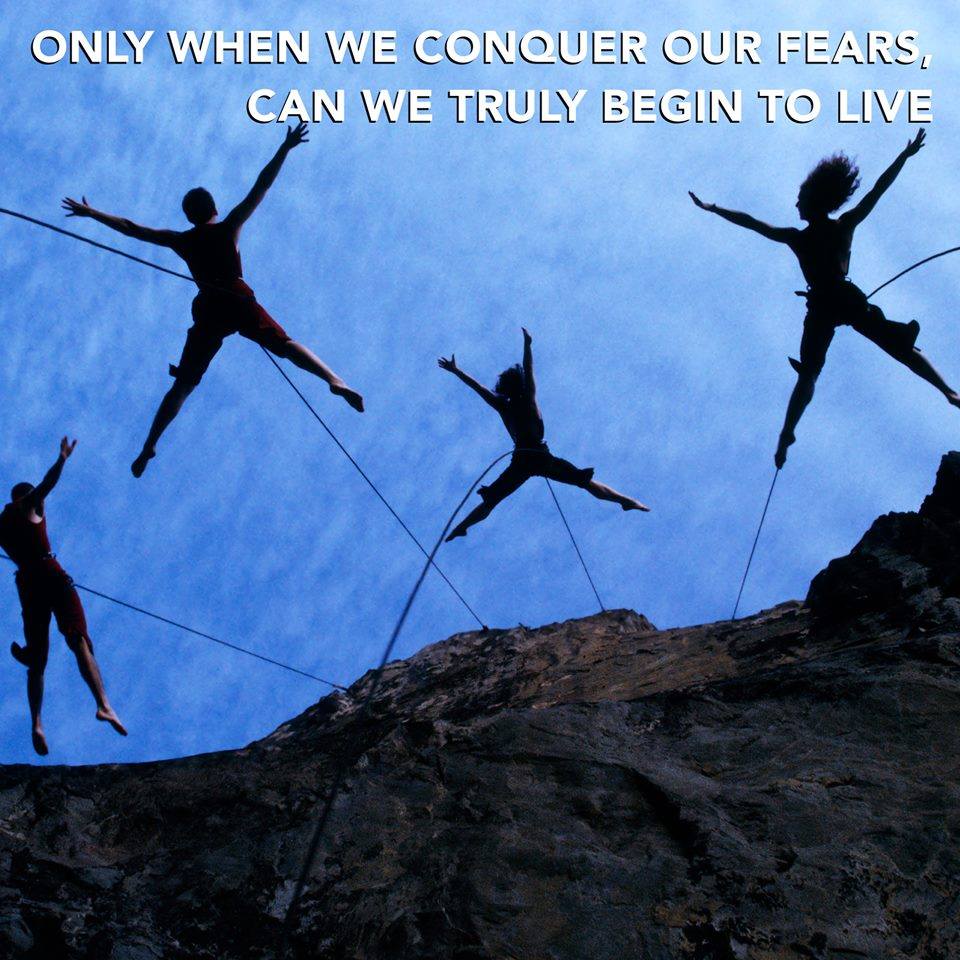
A perfect and simple image to go along with the last few posts I made on ‘Fear’.
Fear holds us back…End of Story!
And we all succumb to it one time or another in our lives!
This is not just fear of doing something hazardous or dangerous, its not the fear of violence or the fear that we may experience when confronted by a dangerous animal, its the ‘Fear of Uncertainty’, the ‘Fear of Failure’, the ‘Fear of Loosing Face’, the ‘Fear of not being good enough’, the ‘Fear of rejection’, the ‘Fear of humiliation’
If you want to move forward with your life you need to confront your fears and become their master.
Life is good my friends and it can be good to you too if you learn to conquer your fears 🙂
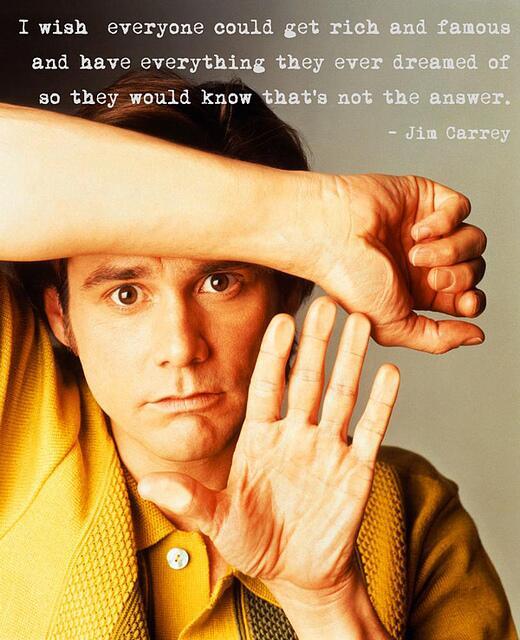
I think I have lost count of the number of times I have said this to my friends, colleagues, students and clients here in China over the past 12 or more years. It’s strange but we are all driven to want more, have more and do more throughout our lives and no more so that emerging countries like China, India, and so on. I guess it’s understandable to want a better life, to have a good job that pays well, to own a house, have a car and enjoy all the trappings that these things bring into your life, but one day you realise that these are just ‘Things’, and they cannot do anything for us in our times of need! They cannot make you well again if you fall terminally ill, they cannot take away the pain of loosing someone close to you or stop the hurting inside if you are in a deep depression. Money does however give you options, I.e to do something or not but it has been my experience that chasing the dream of endless supplies of money and possessions does not bring you happiness, infact it quite often brings deep sadness and loneliness 😦 Jim Carey is not the only one to have experienced this, many millions of people have forged on through their lives searching and working for more, more money, more possessions..things… only to crash and burn when a serious problem falls on them.
I was one of these people who had everything,the very successful company, all the money I could want / need, a beautiful home, big flashy cars worth 100’s of thousands of dollars, the beautiful family, incredible holidays, every possession I could ever need but when that call came from my father telling me my mum had cancer and asking me to do something…Wow! That floored me like a punch from a heavyweight boxer, I was out for the count and there was nothing that all my money and possessions could do, I was lost, in a downward spiral and all I could do was give my mum the love and support she needed, be there for my dad, make sure he was looked after with my family all around him and provide the support for my children in their time of need after her passing. This like many other devastating tragedies that happen to us make you aware of what is in fact important in our lives. Please don’t get me wrong, I don’t say you should not be successful, have dreams or work hard for a living, what I mean is we need to realise what is important to us and to make use of the time we have on this earth, protect ourselves, our families and friends and live our lives with love and happiness in our hearts.
Don’t go through your life pushing ever harder each and everyday and miss what’s around you already, don’t miss out on your children growing up, don’t miss out on the love you can give to your family and friends,…Just Live 🙂
Most of us go about our daily lives in the search of something, it could be searching for success, money, love, friends, or maybe even just searching for things, material things that we think will make us happy, out shopping, time at the mall buying for the sake of buying, keeping the shop owners happy but not ourselves! The purchase gives us the relief; the happiness for a split second in time but once the purchase has been made the thing in the fancy bag is just another thing, another possession to join the many others in our house, closed away in a closet or drawer, maybe not even to see the light of day again; but why?
Why don’t we just stop for a second and take a look around us, look now…Go on,…take a second out of your day and connect with your life…. First of all close your eyes and just breathe, can you feel the air enter your nose, how does it feel? Can you feel the air enter your throat, enter your lungs? How does it feel, is the air warm or cold? Feel the air expand your lungs, can you feel your chest rising, hold the breath at the end of the inhale for a second or two, how and what do you feel? Slowly exhale through your mouth, can you feel the air rushing from your lungs up through your throat and out of your mouth, past your lips, does the air feel warm or cold, is it wet or dry?
What can you smell? Allow your senses to work, keep your eyes closed and smell, can you smell your home, the fragrant air, maybe the smell of a child or pet, how about the smell of cooking or flowers in a vase, take your time and enjoy the sweet smells of your day.
What can you hear? keep your eyes closed and turn your focus inward to your ears, what can you hear, is it raining?, Can you hear raindrops on the windows, dripping from a gutter or maybe a drip from a leaky tap (Faucet), are you using aircon, can you hear the motor, the blades spinning, can you hear birds singing in your garden, children playing, is the radio or TV on what do you hear?
Can you feel and sense your body? Turn your focus inward to your body, can you feel your skin, what does it feel like, is it warm or cool, can you feel the blood circulating into your fingers and toes, do you feel the tingle in the tips of your fingers? Can you feel your heart pumping your life blood around your body,…. focus, focus, focus, feel it?
Now slowly open your eyes and look, really look, what do you see? Take note of the fine detail, the colour of your child’s eyes, the mixture of colours, the colour of their hair, the subtle differences of the shadows on their skin, your pet, what are they doing? Do you have flowers in your room, what are their colours, are they blooming or still in bud, do they need water? Take a look outside, what colour is the sky?, is it daytime or night time, can you see the sun or the moon or are there stars in the sky?
Our world, our life…take a second everyday to appreciate what’s around us, what we already have in our lives and be grateful because there are so many brothers and sisters out there in our world that have far less than we have!
Many of you may have seen this short video before; I had not, so I felt it worthy of posting here on my humble blog. How many of us feel like the people in this video? Walking around each and everyday feeling down, depressed and not worthy! Well, for all of us who need a lift with our spirits, then please watch and enjoy, and remember…You are Worthy, You are Awesome and You are Loved.
“No matter how hard the past, you can always begin again.” ~Buddha
Growing up, I was one of those people much more concerned about what you thought of me than what I thought of me.
With my focus being on how I was being perceived by those around me, it left me feeling extremely unsettled.
I was desperate to be liked and accepted.
“Be who you are and say what you feel, because those who mind don’t matter and those who matter don’t mind” was a nice idea for the fortunate, but certainly not for me.
I was convinced that Dr. Seuss was living in fantasyland!
This social anxiety spread to my work life, too. I wondered why I was never truly happy or successful. I wondered why I didn’t enjoy the rich relationships that so many around me seemed to enjoy.
Then I discovered Zen.
I read that Zen means awareness, and being with what is, as it is.
What I loved most about Zen is its utter simplicity in recognizing what is really true. Not what is partially or sometimes true, but what’s always true.
It didn’t compromise.
I liked that. I wanted that ability to recognize what was always true. That sounded like real emotional freedom to me.
Zen kept telling me truth was simple, so simple that it was often overlooked by the mind that loved to judge, condemn, compare, and resist.
Zen meant to be in alignment with reality as it actually unfolded, not as I wished it would unfold.
Simple indeed!
I saw how my mind loved to complicate things. I saw how my mind resisted so much of what was actually happening.
And I was miserable and stressed out.
I failed to see the inseparable connection between panic and peace—and how resisting one would never reveal the other.
However, as I began to incorporate what I was learning, I found that when I met the anxiety symptoms without running from or avoiding them, my experience began to change, too.
They no longer had control of me.
I had new life.
And I wanted more of it.
Here are the 3 things that dramatically reduced or eliminated the anxiety and panic I had been experiencing. Consider implementing the following and see if it brings you more peace.
1. Meet your panic and anxiety head on.
Zen is essentially about who we’re being in relation to something or someone, and this includes needless anxiety. It also includes this very moment. In fact, especially this very moment, as it shows up, and not as I wish it would show up.
Inherent in anxiety and panic attacks is the belief that it shouldn’t be happening. But this is never true.
No amount of wishing a particular moment to be different than it is can ever change that moment. Many actually think it’s a good strategy, but it rarely ever works out.
Upon closer examination, I saw that whenever I ran from anything, that thing chased me. This included thoughts and feelings.
I found that whenever I faced and embraced anything, it eventually dissolved and left my experience. I was encouraged because I knew I was onto something significant.
I walked around with a new mantra: “What I run from must chase me.”
It served as a great reminder and often snapped me back into being in alignment with what was actually occurring.
Whatever I met head on lost its power, every time. Resistance would often magically drop away. And it was palpable.
I learned that I can either live with the laws that govern me (and all of life) or I can resist them and suffer.
Seeing that I couldn’t escape the consequences of how I met anything, I began to face what was facing me. And that insight, I found, was the difference between living a life of peace versus a living a life of stress.
I began to consciously choose peace.
In fact, any challenging situation (or emotion) that arose wanted to be met by my loving attention.
Stress manifested only if I avoided the negative thoughts and feelings.
If I shined the light of gentle awareness on what wasn’t at peace within me, it had to come out of hiding and release me—because I met it.
2. Allow it to be as it is.
Notice how your mind in its infinite wisdom will tell you that any particular thought, feeling, or experience should or could be different than it presently is.
Is it ever true? Can it ever be true? As much as the mind will try to use logic and reason, it’s never true.
Things are often different than they were, but they are never different than they are!
This may seem counterintuitive, but the reality is we must first accept our present lot if we wish to experience something different in the next moment. We can’t expect to resist our current situation and simultaneously be at peace.
It won’t happen.
The essence of Zen is about being with whatever arises without offering any resistance whatsoever. It’s about being neutral emotionally so that we are in a position to respond appropriately.
Alternatively, resistance is the energy that gives life to what we don’t want.
If we simply allow our symptoms of anxiety to be as they are, we find that they don’t hang around long enough to torture us.
By taking the backward step (as they say in Zen) into this present moment, we discover that peace never left us in the first place.
It just seemed that way.
Allow your anxiety to be as it is, as you look to overcome it.
3. Be compassionate with yourself.
Sure, you’ve heard it before. Be nice to yourself! Get off your back! Stop blaming yourself! The key to effective transformation—turning panic into peace—is to stop beating yourself up and to make yourself the most important person in your life.
Wouldn’t you treat someone who really needed support with kindness and compassion?
Why are you any different?
Perhaps the greatest quality of spirit that the Buddha spoke most about was compassion, not only towards oneself, but to others as well. Compassion is the great neutralizer that has a way of dissolving old wounds, as well as new ones.
The truth is you’re not to blame for your anxiety, but that doesn’t mean you aren’t responsible for it.
You aren’t “crazy” or “weak”—and you’re no less worthy a human being for experiencing it, either. Your mind may tell you different, and even sound very convincing, but is it really true?
No, it isn’t. Not even a little bit.
Work with yourself, not against yourself, if you truly desire to transform your panic into peace. It’s all in how you relate to your current condition. Self-condemnation only gets you more of what you don’t want.
The truth is, you are much more than any thought or feeling that arises. Within you is the power to transform your panic into peace.
As the Buddha said, “Be a light unto yourself.”
Transcending anything never involves rejection, but it always involves acceptance.
About Alex Keats
Alex Keats suffered from extreme anxiety for over five years and now helps people overcome it in all its forms. He is the author of “Born To Be Happy” and “The Dance of Imperfection.” To learn why you stay anxious, and to find out what mistakes to avoid, visit http://www.cure-anxiety-now.com.
Once upon a time in old China a Buddhist Master caught sight of a man running down the road with all his might. He looked exhausted and frantic. “What are you running from?” inquired the Master. “I am running from the wind”, exclaimed the man. “Oh, there is nothing to fear then. Just sit still and it will pass you by”, returned the master. This is a simple enough parable but speaks deeply of Mindfulness and anxiety.
We often spend a huge amount of time and energy running from things. In fact it is a huge problem for society and is in endemic proportion. In our attempts to out run our fear, painful thoughts and feelings, loneliness and unhappiness our methods only end up creating far more suffering. Addictions provide an obvious example. In the attempt to avoid boredom, pain, loneliness, anger and sadness the addict only gets himself into more despair in the long term. As a result of his behaviour he creates guilt, isolation which creates even more loneliness, financial loss which creates even more despair. It is a vicious cycle. We don’t need to be the stereotypic addict to be in this cycle.
Anxiety disorder is another example. It is not the anxiety which creates anxiety disorder. After all, anxiety is a normal emotion which we all experience. At the core of anxiety is avoidance – a life of trying to avoid or get rid of anxiety which in turn creates even more anxiety. This is at the core of a panic attack.
In Mindfulness Training we learn to accept and even give space to unpleasant or painful emotions or thoughts. Mindfulness Training teaches us to accept them for what they are – just thoughts. This is not the same as avoiding or even tolerating unpleasant thoughts. Even tolerating can create a struggle. Many therapies aim at symptom reduction or eradication. The problem here is that we will always be “checking” to see is the symptom is going or gone thus creating what we are trying to get rid of – the anxiety!
At the heart of Mindfulness Training is giving space for the anxiety to be. We are able to stand back out of the struggle as if we are the spectators of a boxing match. We watch the fight but we are not part of it being punched up by the thoughts and feelings. Mindfulness is about breathing into the anxiety and giving it space, naming it, watching it like some creature from out of space but never giving in to it.
If we try to run form our anxiety we will exhaust ourselves like the man running from the wind. The old Master was right. Sit still, breathe, observe and it will pass you by.
Wow, I receive a very profound question from one of our fellow bloggers bert0001 in regard to one of my recent posts ‘Mindfulness’, as follows :-
“I have a profound question here. I wrote a post last week about the difference between awareness and metacognition. And here I see mindfulness. I know that this has been around for 25 years in the Western Hemisphere and that it is a watered down version coming from buddhism. But in a way, this video makes me pleasantly agitated. There is no answer here. It is like publicity for sigarets. And if I walk around the internet, I see 700 different interpretations of mindfulness, awareness, metacognition and so on.
Many people, if not most think that meditation is sitting cross legged, listening to Enya in the vicinity of a candle and some incense.
So let me come back to the question. Could you give a concise and correct definition of mindfulness, in respect with my brain and mind, so that people know when they are mindfull and when they are mindless. (like me right now )”
Well, as I replied to bert0001, this is certainly a very profound question and one in which I’m sure is debated and contested on a daily basis all around the world especially between Scientists of the Mind and Traditional Religions and Buddhism followers across the globe. So in order for me to try and reply to bert0001’s question as best as possible I have attached two items to this post, the first one is an article by Thanissaro Bhikkhu re a definition of Mindfulness from a Buddhist perspective and the second a YouTube video by Professor Mark Williams from Oxford University Science who provides in my mind an excellent presentation on Mindfulness from a Mindfulness Cognitive Therapy perspective which clearly links both the science of the mind and the ancient Buddhist forms and practice of meditation techniques to help aid both clinical patients suffering from Depression, ADHD, Anxiety Health Issues, Child Birth etc; and also for everyday use by general members of the public who wish to re-connect with themselves on a daily basis due to the stresses and pressures of everyday life.
I do hope these items help you all with your understanding of Mindfulness and how its use can help us all in our daily lives 🙂 Namaste Mark
What does it mean to be mindful of the breath? Something very simple: to keep the breath in mind. Keep remembering the breath each time you breathe in, each time you breathe out. The British scholar who coined the term “mindfulness” to translate the Pali word sati was probably influenced by the Anglican prayer to be ever mindful of the needs of others—in other words, to always keep their needs in mind. But even though the word “mindful” was probably drawn from a Christian context, the Buddha himself defined sati as the ability to remember, illustrating its function in meditation practice with the four satipatthanas, or establishings of mindfulness.
“And what is the faculty of sati? There is the case where a monk, a disciple of the noble ones, is mindful, highly meticulous, remembering & able to call to mind even things that were done & said long ago. (And here begins the satipatthana formula:) He remains focused on the body in & of itself — ardent, alert, & mindful — putting aside greed & distress with reference to the world. He remains focused on feelings in & of themselves… the mind in & of itself… mental qualities in & of themselves — ardent, alert, & mindful — putting aside greed & distress with reference to the world.”
The full discussion of the satipatthanas (DN 22) starts with instructions to be ever mindful of the breath. Directions such as “bring bare attention to the breath,” or “accept the breath,” or whatever else modern teachers tell us that mindfulness is supposed to do, are actually functions for other qualities in the mind. They’re not automatically a part of sati, but you should bring them along wherever they’re appropriate.
One quality that’s always appropriate in establishing mindfulness is being watchful or alert. The Pali word for alertness, sampajañña, is another term that’s often misunderstood. It doesn’t mean being choicelessly aware of the present, or comprehending the present. Examples in the Canon shows that sampajañña means being aware of what you’re doing in the movements of the body, the movements in the mind. After all, if you’re going to gain insight into how you’re causing suffering, your primary focus always has to be on what you’re actually doing. This is why mindfulness and alertness should always be paired as you meditate.
In the Satipatthana Sutta, they’re combined with a third quality, ardency. Ardency means being intent on what you’re doing, trying your best to do it skillfully. This doesn’t mean that you have to keep straining and sweating all the time, just that you’re continuous in developing skillful habits and abandoning unskillful ones. Remember, in the eight factors of the path to freedom, right mindfulness grows out of right effort. Right effort is the effort to be skillful. Mindfulness helps that effort along by reminding you to stick with it, so that you don’t let it drop.
All three of these qualities get their focus from what the Buddha called yoniso manasikara, appropriate attention. Notice: That’s appropriate attention, not bare attention. The Buddha discovered that the way you attend to things is determined by what you see as important: the questions you bring to the practice, the problems you want the practice to solve. No act of attention is ever bare. If there were no problems in life you could open yourself up choicelessly to whatever came along. But the fact is there is a big problem smack dab in the middle of everything you do: the suffering that comes from acting in ignorance. This is why the Buddha doesn’t tell you to view each moment with a beginner’s eyes. You’ve got to keep the issue of suffering and its end always in mind.
Otherwise inappropriate attention will get in the way, focusing on questions like “Who am I?” “Do I have a self?”—questions that deal in terms of being and identity. Those questions, the Buddha said, lead you into a thicket of views and leave you stuck on the thorns. The questions that lead to freedom focus on comprehending suffering, letting go of the cause of suffering, and developing the path to the end of suffering. Your desire for answers to these questions is what makes you alert to your actions—your thoughts, words, and deeds—and ardent to perform them skillfully.
Mindfulness is what keeps the perspective of appropriate attention in mind. Modern psychological research has shown that attention comes in discrete moments. You can be attentive to something for only a very short period of time and then you have to remind yourself, moment after moment, to return to it if you want to keep on being attentive. In other words, continuous attention—the type that can observe things over time—has to be stitched together from short intervals. This is what mindfulness is for. It keeps the object of your attention and the purpose of your attention in mind.
Popular books on meditation, though, offer a lot of other definitions for mindfulness, a lot of other duties it’s supposed to fulfill—so many that the poor word gets totally stretched out of shape. In some cases, it even gets defined as Awakening, as in the phrase, “A moment of mindfulness is a moment of Awakening”—something the Buddha would never say, because mindfulness is conditioned and nirvana is not.
These are not just minor matters for nitpicking scholars to argue over. If you don’t see the differences among the qualities you’re bringing to your meditation, they glom together, making it hard for real insight to arise. If you decide that one of the factors on the path to Awakening is Awakening itself, it’s like reaching the middle of a road and then falling asleep right there. You never get to the end of the road, and in the meantime you’re bound to get run over by aging, illness, and death. So you need to get your directions straight, and that requires, among other things, knowing precisely what mindfulness is and what it’s not.
I’ve heard mindfulness defined as “affectionate attention” or “compassionate attention,” but affection and compassion aren’t the same as mindfulness. They’re separate things. If you bring them to your meditation, be clear about the fact that they’re acting in addition to mindfulness, because skill in meditation requires seeing when qualities like compassion are helpful and when they’re not. As the Buddha says, there are times when affection is a cause for suffering, so you have to watch out.
Sometimes mindfulness is defined as appreciating the moment for all the little pleasures it can offer: the taste of a raisin, the feel of a cup of tea in your hands. In the Buddha’s vocabulary, this appreciation is called contentment. Contentment is useful when you’re experiencing physical hardship, but it’s not always useful in the area of the mind. In fact the Buddha once said that the secret to his Awakening was that he didn’t allow himself to rest content with whatever attainment he had reached. He kept reaching for something higher until there was nowhere higher to reach. So contentment has to know its time and place. Mindfulness, if it’s not glommed together with contentment, can help keep that fact in mind.
Some teachers define mindfulness as “non-reactivity” or “radical acceptance.” If you look for these words in the Buddha’s vocabulary, the closest you’ll find are equanimity and patience. Equanimity means learning to put aside your preferences so that you can watch what’s actually there. Patience is the ability not to get worked up over the things you don’t like, to stick with difficult situations even when they don’t resolve as quickly as you want them to. But in establishing mindfulness you stay with unpleasant things not just to accept them but to watch and understand them. Once you’ve clearly seen that a particular quality like aversion or lust is harmful for the mind, you can’t stay patient or equanimous about it. You have to make whatever effort is needed to get rid of it and to nourish skillful qualities in its place by bringing in other factors of the path: right resolve and right effort.
Mindfulness, after all, is part of a larger path mapped out by appropriate attention. You have to keep remembering to bring the larger map to bear on everything you do. For instance, right now you’re trying to keep the breath in mind because you see that concentration, as a factor of the path, is something you need to develop, and mindfulness of the breath is a good way to do it. The breath is also a good standpoint from which you can directly observe what’s happening in the mind, to see which qualities of mind are giving good results and which ones aren’t.
Meditation involves lots of mental qualities, and you have to be clear about what they are, where they’re separate, and what each one of them can do. That way, when things are out of balance, you can identify what’s missing and can foster whatever is needed to make up the lack. If you’re feeling flustered and irritated, try to bring in a little gentleness and contentment. When you’re lazy, rev up your sense of the dangers of being unskillful and complacent. It’s not just a matter of piling on more and more mindfulness. You’ve got to add other qualities as well. First you’re mindful enough to stitch things together, to keep the basic issues of your meditation in mind and to observe things over time. Then you try to notice—that’s alertness—to see what else to stir into the pot.
It’s like cooking. When you don’t like the taste of the soup you’re fixing, you don’t just add more and more salt. Sometimes you add onion, sometimes garlic, sometimes oregano—whatever you sense is needed. Just keep in mind the fact that you’ve got a whole spice shelf to work with.
And remember that your cooking has a purpose. In the map of the path, right mindfulness isn’t the end point. It’s supposed to lead to right concentration.
We’re often told that mindfulness and concentration are two separate forms of meditation, but the Buddha never made a clear division between the two. In his teachings, mindfulness shades into concentration; concentration forms the basis for even better mindfulness. The four establishings of mindfulness are also the themes of concentration. The highest level of concentration is where mindfulness becomes pure. As Ajaan Lee, a Thai Forest master, once noted, mindfulness combined with ardency turns into the concentration factor called vitakka or “directed thought,” where you keep your thoughts consistently focused on one thing. Alertness combined with ardency turns into another concentration factor: vicara, or “evaluation.” You evaluate what’s going on with the breath. Is it comfortable? If it is, stick with it. If it’s not, what can you do to make it more comfortable? Try making it a little bit longer, a little bit shorter, deeper, more shallow, faster, slower. See what happens. When you’ve found a way of breathing that nourishes a sense of fullness and refreshment, you can spread that fullness throughout the body. Learn how to relate to the breath in a way that nourishes a good energy flow throughout the body. When things feel refreshing like this, you can easily settle down.
You may have picked up the idea that you should never fiddle with the breath, that you should just take it as it comes. Yet meditation isn’t just a passive process of being nonjudgmentally present with whatever’s there and not changing it at all. Mindfulness keeps stitching things together over time, but it also keeps in mind the idea that there’s a path to develop, and getting the mind to settle down is a skillful part of that path.
This is why evaluation—judging the best way to maximize the pleasure of the breath—is essential to the practice. In other words, you don’t abandon your powers of judgment as you develop mindfulness. You simply train them to be less judgmental and more judicious, so that they yield tangible results.
When the breath gets really full and refreshing throughout the body, you can drop the evaluation and simply be one with the breath. This sense of oneness is also sometimes called mindfulness, in a literal sense: mind-fullness, a sense of oneness pervading the entire range of your awareness. You’re at one with whatever you focus on, at one with whatever you do. There’s no separate “you” at all. This is the type of mindfulness that’s easy to confuse with Awakening because it can seem so liberating, but in the Buddha’s vocabulary it’s neither mindfulness nor Awakening. It’s cetaso ekodibhava, unification of awareness—a factor of concentration, present in every level from the second jhana up through the infinitude of consciousness. So it’s not even the ultimate in concentration, much less Awakening.
Which means that there’s still more to do. This is where mindfulness, alertness, and ardency keep digging away. Mindfulness reminds you that no matter how wonderful this sense of oneness, you still haven’t solved the problem of suffering. Alertness tries to focus on what the mind is still doing in that state of oneness—what subterranean choices you’re making to keep that sense of oneness going, what subtle levels of stress those choices are causing—while ardency tries to find a way to drop even those subtle choices so as to be rid of that stress.
So even this sense of oneness is a means to a higher end. You bring the mind to a solid state of oneness so as to drop your normal ways of dividing up experience into me vs. not-me, but you don’t stop there. You then take that oneness and keep subjecting it to all the factors of right mindfulness. That’s when really valuable things begin to separate out on their own. Ajaan Lee uses the image of ore in a rock. Staying with the sense of oneness is like being content simply with the knowledge that there’s tin, silver, and gold in your rock: If that’s all you do, you’ll never get any use from them. But if you heat the rock to the melting points for the different metals, they’ll separate out on their own.
Liberating insight comes from testing, experimenting. This is how we learn about the world to begin with. If we weren’t active creatures, we’d have no understanding of the world at all. Things would pass by, pass by, and we wouldn’t know how they were connected because we’d have no way of influencing them to see which effects came from changing which causes. It’s because we act in the world that we understand the world.
The same holds true with the mind. You can’t just sit around hoping that a single mental quality—mindfulness, acceptance, contentment, oneness—is going to do all the work. If you want to learn about the potentials of the mind, you have to be willing to play—with sensations in the body, with qualities in the mind. That’s when you come to understand cause and effect.
And that requires all your powers of intelligence—and this doesn’t mean just book intelligence. It means your ability to notice what you’re doing, to read the results of what you’ve done, and to figure out ingenious ways of doing things that cause less and less suffering and stress: street smarts for the noble path. Mindfulness allows you to see these connections because it keeps reminding you always to stay with these issues, to stay with the causes until you see their effects. But mindfulness alone can’t do all the work. You can’t fix the soup simply by dumping more pepper into it. You add other ingredients, as they’re needed.
This is why it’s best not to load the word mindfulness with too many meanings or to assign it too many functions. Otherwise, you can’t clearly discern when a quality like contentment is useful and when it’s not, when you need to bring things to oneness and when you need to take things apart.
So keep the spices on your shelf clearly labeled, and learn through practice which spice is good for which purpose. Only then can you develop your full potential as a cook.
Terms of use: You may copy, reformat, reprint, republish, and redistribute this work in any medium whatsoever, provided that: (1) you only make such copies, etc. available free of charge; (2) you clearly indicate that any derivatives of this work (including translations) are derived from this source document; and (3) you include the full text of this license in any copies or derivatives of this work. Otherwise, all rights reserved. For additional information about this license, see the FAQ.
How to cite this document (one suggested style): “Mindfulness Defined”, by Thanissaro Bhikkhu. Access to Insight, 1 December 2012,




 Endless Light and Love