It’s the end of yet another day, a productive and happy day but as I sit here quietly contemplating I can feel tears rolling down my face one more time, tears of sadness and despair so I sit and wonder if my spiritual journey is becoming too much for me to bare….I ask myself ‘Why me, Why Now’, ‘What do I have to do?…..
Our spiritual journeys are all very different and our aims, needs and destinations are all very different too! In my case, I have no idea as to why I have been chosen to follow a spiritual journey; but all I know is, I must follow the path and help as many people as I can along the way.
My days and nights are often full of sadness, trying to juggle family life, business life, friendships and relationships at home and abroad whilst also trying to follow a spiritual pathway to an end we often still don’t understand. I have always been a soft hearted man, easy going as many might say, always putting the needs of friends, employees and business relationships before thinking of; or, caring for myself, never putting anyone down, smiling as often as possible and trying to keep a cheerful, sunny, caring disposition as much as possible, and certainly not intentionally doing anything to hurt or harm anyone or anything as I go. However, what I don’t understand is ‘why do our friends treat us differently as we grow spiritually? It’s like they no longer trust us, or think were doing something underhand, untoward or against them! They become distant and off-hand with us for no reason! Maybe its just me overthinking things too much or maybe it’s their lack of understanding or nervousness of where we may be headed…I honestly don’t know why they change, but I do know it’s upsetting and it breaks my heart! When we honestly ask ourselves which person or people in our lives mean the most to us, we often find that it is those friends who, instead of giving much advice, solutions, or cures, have chosen rather to share our journey, help us through the spiritual growing pains we are going through and touch our battle wounds with a gentle and tender supporting hand. The friend’s who we care for dearly who can be silent when the time is right and also offer words of wisdom and support to us in our moments of frustration, despair, lack of energy or general spiritual confusion, friends who can stay with us in our hours of need, who can tolerate not knowing, not curing, not healing and face with us the reality of our powerlessness, that is in my opinion a friend who cares.
I still don’t know where I’m heading but I know I’m on the right pathway, I keep checking my direction at each and every kink and curve in the road, and look for clarity along the way. I don’t possess to be anything special, I’m just a simple man who needs to follow his destiny and love and help people along the way.
So my dear friends please, please be open and honest with each other because friendship is precious and love is needed by all, not just the few!
‘You’, ‘Yes You my friend’ are the light of god. You are here by God’s grace, it’s irrelevant which religion you believe in but ‘You’, ‘Yes You’ are a gift to this world from your God.
Every human on this planet was brought into life on God’s wish, we were all born for a reason, it is our destiny to do good, to exude Love, compassion and Happiness and bring light to this world and to look after our world, look after and protect each other and our environment…Most; however get lost along the way!
Our abilities to shine our light, to do the right thing, to help others, to help protect our environment and to heal ourselves becomes lost and blocked over time when during our childhood and teenage years we were told things like, ‘Don’t Be Silly’, ‘Ah, they are all right they are just beggars, they probably have more money than us’, ‘ It’s no good giving money because it gets taken by their government’, ‘You cannot do this’, ‘You cannot do that’, ‘You need to see the doctor because your ill’, ‘Don’t talk to that imaginary friend, he or she does not exist’, ‘Oh that’s ok it’s not in our country, you know what those foreigners are like’ etc; etc.
Were brainwashed to give up our natural skills and abilities, to live life with an open mind and an open heart, to see with compassion, to use our intuitions and inner abilities to diagnose our ills and heal ourselves. Our parents, siblings and families help us during our growing years to block out the realities of life and keep us ‘Safe’ from the world and all it’s dangers and we become conditioned to follow like sheep and do as everyone as done before us! ‘Please don’t get me wrong’, our parents are doing what they think best and passing on the knowledge that was passed on to them.
It’s interesting and encouraging to see that ‘Slowly’ things are now changing, more people all around the world are starting to wake up, they are opening their eyes for the first time and noticing that ‘This World is in Pain’, ‘People are in pain’, ‘Countries are in pain’, ‘Our environment is in pain’ and ‘Pollution and contamination is everywhere’.
Our oceans are full of garbage and our man made poisons and toxins are killing off our natural sources of food and water.
The lungs of our planet (our trees) are being cut down in the name of ‘progress and profit’ and replaced with more housing and more factories, which then adds to the pollution in areas that were once pristine and toxin free! De-forestation adds more dust and sand particles to the atmosphere (Google PM2.5 to learn more) which then creates a change in the weather so more storms are created which then increases breathing related problems like asthma, bronchitis and even worse.
I ask you all to begin today and for you to see the difference between the absence of light versus the mental construct of darkness or the dark forces in the Universe.
Darkness cannot deny light, never has, never will. In many situations, you can cover up your light, deny your light, and ignore your light. Some do this to such an extent that they may not remember their own Divinity, their own light, their own birthright, their own Spiritual heritage; however, that does not mean there are dark forces attempting to take your soul, or dark forces effecting your existence.
Begin today to see that darkness is part of your conditionings, a mentally established, manufactured assembly, and a fabrication of your religion. It is one of the great illusions. You are born from the light of God, uncover it, and allow that light to shine big and bright!
And please, open your eyes to what is really happening all around us, Our Planet is being Destroyed little by little, each and every day…What will it take for your to do something?
Today is the 20th day of March the ‘International Day of Happiness’ and I’m sure there are many millions of people out there all around the world who have NO happiness in their lives today! Their lives full of sadness, fear, hunger and tragedy.
What will you do today on this day of happiness to try and make someone else happy if only for a minute?
“What is important is to look upon everyone with a deep sense of honor, because your own heart and mind are influenced by the way you look at others. If we could do just that, we would be rendering the greatest service to our fellow beings.”
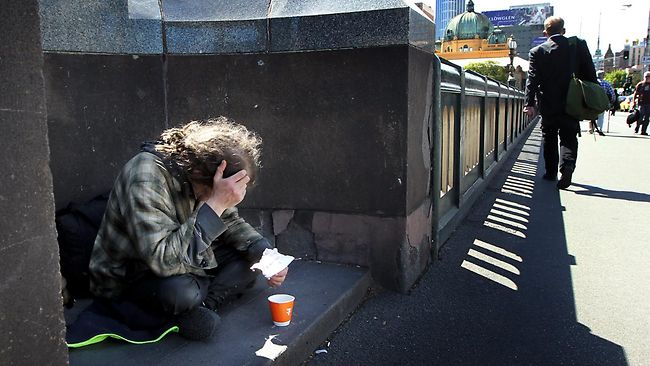
The young man above did just that, he took the time to honour the beggar and not just give him money but feed him food 🙂
Treat everyone with Respect and Honour them as fellow human beings, if we all started to do this, this world we live in will become a better place for us all to live and for our grandchildren and great grandchildren to grow up with love, happiness and compassion imbedded in their hearts, minds and souls:)
You know the feeling and the wondering…I wonder where my money went that I donated to charity…well, here is one example 🙂
Please don’t stop giving just because you are unsure where your hard earned cash goes, there is still hope left in our world and together we can make a change 🙂
“Some people do not know the difference between mindfulness and concentration. They concentrate on what they’re doing, thinking that is being mindful. . . . We can concentrate on what we are doing, but if we are not mindful at the same time, with the ability to reflect on the moment, then if somebody interferes with our concentration, we may blow up, get carried away by anger at being frustrated.
If we are mindful, we are aware of the tendency to first concentrate and then to feel anger when something interferes with that concentration. With mindfulness we can concentrate when it is appropriate to do so and not concentrate when it is appropriate not to do so. ”
~ Ajahn Sumedho
First of all I would like to say a big ‘Sorry ‘for not writing an update on My Spiritual Journey for such a long time, but hey, here is part 3, better late than never and we are now only about a year behind the current date, so, maybe with two more updates I can bring you to where I am right now. I will also add this post to the first two articles on my home page under ‘My Spiritual Journey’, if you would like to read it all at once.
Namaste my friends
Mark
My Spiritual Journey Part 3.
Joyce and I have met three times since that first session in Shanghai and almost two years have past me bye and what a period it has been, filled with very sad and tough times and so many happy experiences too.
My spiritual awareness and growth has continued, and my intuitions and senses have become more refined and sensitive which has it’s good points and bad points. My sense of smell and touch is now so acute and even the slightest change in temperature or weather (rain) can be felt at least one day before it happens. I seem to know when the pollution levels are getting worse, again, at least one day before it happens! My throat starts to swell, it gets very sore and I cough continually just as it did when I had childhood asthma so many years ago. I tried to make sense of what Joyce and Noriko had told me but always my logical mind made me stop to think
“Why Me, Why Now”
I felt myself reaching out and touching people, not really touching (please don’t think I’m crazy) but just a soft touch to the arm or shoulder when we spoke, I noticed this more and more often over the past year or so and I even noticed some people reaching out and touching me, especially older people or young children. Our friends often handed me their babies and for some reason they lye in my arms for hours, never stirring or waking J Animals started coming to me without me calling them, horses who were way off in a field came running over to us as we walked by their field and stopped by us until we decided to leave, even hundreds of Koi Fish and Goldfish in our local Buddhist temple make their way over to me every time we go and as I sit and meditate by their pool they stay close even when they are being fed by all the temple patrons at the other end of the pool! Cats of which I have never been keen and fond of came up to me freely, sit on my lap and snuggle down to sleep, this happens so often and still continues.
The Law of Attraction works for me continually, I only need to think about something and it happens very quickly, if I think too much about spiritual issues that are in my head an answer comes to me via email, by phone or by meeting someone out of the blue.
I can think of a friend even in another country and within a few minutes they call me or I receive an email, I think about business or getting a new contact and it happens. All these things are great, they are all positive and right for all the right reasons, but as always my logical mind kept asking
“Why Me”, “Why Now”
We were going through a really happy period in our lives, the children were all doing well at work and in their studies, work was good, we were all healthy and happy, so, my wife and I decided to go back to the UK to spend Christmas with my father and to see my beautiful children and family. This was a spur of the moment decision because we had only just got back from our UK holiday three months before this decision was made. My dad had taken a tumble at home a couple of times and as he was fit and healthy and never been ill in his life there was no cause for alarm or concern from the doctors and nursing teams who checked him out, all tests came back ok, no problems or issues were found, he was as they said, fit and healthy…He fell again and was admitted into a emergency care home until he got better, this is where he was when my wife and I returned home a day or two before Christmas.
My dad was not particularly compos mentis, which was certainly not like him at all, he would drift in and out of conversations; one minute being lucid and happy the next down and forgetful. We noticed he was loosing weight quite rapidly… he said he hated the food in the care home, it had no taste and that was why he was loosing weight! So we made him food, brought him food and as we thought made sure he was eating well, but then we found uneaten sandwiches hidden in his jacket pockets and food in the waste bin in his room…We took him out on Christmas Day and Boxing day, home for lunch on both days to see the grandchildren and great grandchildren. He watched TV, laughed and smiled and enjoyed the freedom away from the care home. On the 28th December I took him to the county hospital for a series of neurological tests and after being prodded and shocked he, for the first time told the consultant he was not feeling so well! Three days later he was diagnosed with Motor Neuron Disease, the same disease that Steven Hawking has; however, my father was a few day short of his 83rd Birthday, so this was going to be an uphill battle. And as the consultants told us there was nothing that could be done for him and things would become worse over the months to come. A couple of days past by and dad became ill with a slight cold and cough, so to be safe he was admitted into hospital where they could monitor him more effectively and give him the care and medication he needed to fight off the chest infection which quickly turned into Pneumonia. We stayed with him 24 hours a day and early one morning around 5:30 am my wife called me from the hospital, she was on the night shift with him that night and soon it was my turn to replace her so she could also get a few hours sleep, but this call was different, she needed me to speak to him on the phone, he was becoming agitated and aggressive with her and the nursing staff. I spoke to him and asked him to calm down, to be nice to the nurses and tell him I was on my way to the hospital…He said “Mark I’ve had enough, I don’t want this anymore”, I rushed to the hospital and arrived there within 20 minutes of that call. As soon as he saw me, he switched off and slipped into a coma, all our family, his children, our children and their children were with him as he passed away peacefully on the 13th January 2012 and joined the love of his life my mum Marion, his childhood sweetheart and soul mate since the age of 14.
If only we could all open our eyes and see the wonders that Mother Nature lays out for us each and every day!
Infinite beauty is everywhere, in the first light of day, the wind through the trees, flowers in bloom, the sweet scent of a rose, song birds calling out, insects chattering, rivers meandering quietly through the countryside, ocean waves breaking on the shoreline, children laughing as they play in the yard or on the street side, senior citizens chatting as they pass the time of day, the quietness of a smile that makes your day as its passed to you by a stranger on the street to the quietness of the closing of the day, the clouds, the stars….What a wonderful world…
Let’s Open our Eyes and Live 🙂
I would like to dedicate this post to my mum on Mother’s Day, her beauty and wisdom will ‘Always’ be with me..RIP with the Angels..with Love Mark
You may not hear a lot about adult bullying, but it is a problem. Read this article to learn more about different types of adult bullies and get some ideas on how to deal with an adult bully. Adult bullying is a serious problem and may require legal action.
One would think that as people mature and progress through life, that they would stop behaviors of their youth. Unfortunately, this is not always the case. Sadly, adults can be bullies, just as children and teenagers can be bullies. While adults are more likely to use verbal bullying as opposed to physical bullying, the fact of the matter is that adult bullying exists. The goal of an adult bully is to gain power over another person, and make himself or herself the dominant adult. They try to humiliate victims, and “show them who is boss.”
There are several different types of adult bullies, and it helps to know how they operate:
Narcissistic Adult Bully: This type of adult bully is self-centered and does not share empathy with others. Additionally, there is little anxiety about consequences. He or she seems to feel good about him or herself, but in reality has a brittle narcissism that requires putting others down.
Impulsive Adult Bully: Adult bullies in this category are more spontaneous and plan their bullying out less. Even if consequences are likely, this adult bully has a hard time restraining his or her behavior. In some cases, this type of bullying may be unintentional, resulting in periods of stress, or when the bully is actually upset or concerned about something unconnected with the victim.
Physical Bully: While adult bullying rarely turns to physical confrontation, there are, nonetheless, bullies that use physicality. In some cases, the adult bully may not actually physically harm the victim, but may use the threat of harm, or physical domination through looming. Additionally, a physical bully may damage or steal a victim’s property, rather than physically confronting the victim.
Verbal Adult Bully: Words can be quite damaging. Adult bullies who use this type of tactic may start rumors about the victim, or use sarcastic or demeaning language to dominate or humiliate another person. This subtle type of bullying also has the advantage – to the bully – of being difficult to document. However, the emotional and psychological impacts of verbal bullying can be felt quite keenly and can result in reduced job performance and even depression.
Secondary Adult Bully: This is someone who does not initiate the bullying, but joins in so that he or she does not actually become a victim down the road. Secondary bullies may feel bad about what they are doing, but are more concerned about protecting themselves.
Workplace bullying can make life quite miserable and difficult. Supervisors should be made aware of adult bullies, since they can disrupt productivity, create a hostile work environment (opening the company to the risk of a law suit) and reduce morale.
It is important to note, though, that there is little you can do about an adult bully, other than ignore and try to avoid, after reporting the abuse to a supervisor. This is because adult bullies are often in a set pattern. They are not interested in working things out and they are not interested in compromise. Rather, adult bullies are more interested in power and domination. They want to feel as though they are important and preferred, and they accomplish this by bringing others down. There is very little you can do to change an adult bully, beyond working within the confines of laws and company regulations that are set up. The good news is that, if you can document the bullying, there are legal and civil remedies for harassment, abuse and other forms of bullying. But you have to be able to document the case.
Adult bullies were often either bullies as children, or bullied as children. Understanding this about them may be able to help you cope with the behavior. But there is little you can do about it beyond doing your best to ignore the bully, report his or her behavior to the proper authorities, and document the instances of bullying so that you can take legal action down the road if necessary.
A Simple Story:
A teacher in New York was teaching her class about bullying and gave them the following exercise to perform. She had the children take a piece of paper and told them to crumple it up, stamp on it and really mess it up but do not rip it. Then she had them unfold the paper, smooth it out and look at how scarred and dirty is was.
She then told them to tell it (The Piece of Paper) they’re sorry.
Now even though they said they were sorry and tried to fix the paper, she pointed out all the scars they had left behind. And that those scars will never go away no matter how hard they tried to fix it.
That is what happens when people bully and hurt others, they may say they’re sorry but the scars are there forever.
The looks on the faces of the children in the classroom told her the message hit home.
It’s time to let go, to be yourself and to enjoy your life to the full, cast away your fears and your doubts, stop worrying about others and what they think of you, You are You and you are your own spirit, so break free from the chains that hold you down…
Negativity is viral. It spreads quickly, as it is infectious. Stay with a negative person for a while and you will be infected, from out of nowhere your mind will fall into a negative, downward spiral! You know very well that in your family, or in your work place, you are surrounded by umpteen numbers of the carrier of this deadly disease. Negativity is the root cause of diseases.
We need to discuss various ways and means to take care of this root disease of all illnesses of mind and body.
Let us not forget that the breeding ground of all mind-body diseases start with our thoughts. Is there anything that can be prescribed to rid ourselves of this most potent negative virus? Are there any home remedies we can use to fight off our negative thoughts?
Just as when you feel so healthy and happy when you drink pure water, you can also gift yourself the joy of drinking the positive thoughts of your mind that will eventually purify the water of your body. That is what you are, water and space! Your thoughts purify water and your thoughts purify space!!!!
It is so surprising that we are so careful that we don’t ever compromise on the quality of drinking water. We have the best purifiers and always make sure we drink pure water, uncontaminated by any poisonous chemicals.
But how come we poison the water of our body (approximately 70% of it is water) with poisonous chemicals and disease producing hormones, and suffer with all kinds of dis-ease! Let us not forget that our negative thoughts or attitude about life are more poisonous than anything else. You are not only inhaling polluted air, but are poisoning the water of your body with negative thoughts.
With positive thoughts, the water of your body can become purified, and lead you to health, both in body and in mind.
But this process of self-purification can be very difficult. Most people today are surrounded by and bombarded with all kinds of negative environments at home and in the work place! That is the reason I am trying to share with you all that until we focus FIRST on changing the INNER ENVIRONMENT, the outer environmental support will not come to us.
As you know, negativity is destructive. It destroys much of your natural tendencies to stand firm for higher goals of life. It sucks your energy from inside, and your self-esteem or your self-confidence is afflicted with this negative force. It robs your good qualities and divine potentials.
Your goal is to take charge of your thoughts, not others’ thoughts, and let them flow, not succumbing to the pull of the instinctive lower mind. Lift your thoughts with your own mind. For your mind can be heaven or it can be hell, either of which are your own creation.
Intensify your conviction that you alone can change the thoughts of your mind. Deeply realize that every thought creates an outcome according to its own nature.
In my book, Making Your Mind Your Best Friend, you are taught to befriend your own mind. Basically the idea is that through meditative practices you begin to learn to anchor yourself with the Spirit within.
Identify the areas that trigger your negativity. Identify the persons who push you into negative brooding. From now on try to evoke your positive energy. Always think well about those persons and try to be more conscious and alert when you face situations that trigger your negative impulses. You have to gradually lighten up the areas that suffer with lesser light.
The whole process is one of your awakening the self-management part in your mind, which unfortunately no universities in the world care to teach. The more you become aware of your strengths, and at the same time your weaknesses, the more it is possible for you to reinforce your strengths and work vigilantly to transform your weaknesses into strengths of your character.
The whole universe is continually supporting you if only you accept, acknowledge, and arise to the situations that demand your Mindfulness.
Keep working throughout the day, and when you retire to bed and are about to fall asleep, sit erect, relax your body, and focus your mind on your breathing. Feel a sense of calm descending upon your being and at that point of time impregnate into your subconscious mind positive affirmations about how good your life can be. When your mind is calm and your body is relaxed, the gateway to universal intelligence opens up. Then whatever you commune reaches to the subtler regions of your own being. Your transformation is assured. You’re on your way to freedom!
If you vigilantly work on your thoughts, and make sure that they are not like a stagnant pool, but like a flowing crystalline creek, then you can be sure that your thoughts will flow with the rhythm of the Universal Laws. From Laws of attraction, to laws of forgiveness, to laws of acceptance, and to laws of transcendence you will flow. Your positive thoughts will purify your mind, and your body, and the water and space within. You have truly begun to heal yourself from the inside-out and to immunize yourself against the virus of negativity!
By Baba Shuddhaanandaa Brahmachari
I truly hope you enjoyed this article and start to or continue to ‘Think Positive Thoughts’ from today onward!
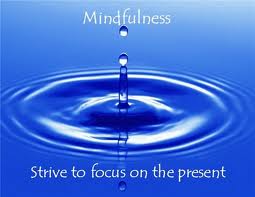
Wow, I receive a very profound question from one of our fellow bloggers bert0001 in regard to one of my recent posts ‘Mindfulness’, as follows :-
“I have a profound question here. I wrote a post last week about the difference between awareness and metacognition. And here I see mindfulness. I know that this has been around for 25 years in the Western Hemisphere and that it is a watered down version coming from buddhism. But in a way, this video makes me pleasantly agitated. There is no answer here. It is like publicity for sigarets. And if I walk around the internet, I see 700 different interpretations of mindfulness, awareness, metacognition and so on.
Many people, if not most think that meditation is sitting cross legged, listening to Enya in the vicinity of a candle and some incense.
So let me come back to the question. Could you give a concise and correct definition of mindfulness, in respect with my brain and mind, so that people know when they are mindfull and when they are mindless. (like me right now )”
Well, as I replied to bert0001, this is certainly a very profound question and one in which I’m sure is debated and contested on a daily basis all around the world especially between Scientists of the Mind and Traditional Religions and Buddhism followers across the globe. So in order for me to try and reply to bert0001’s question as best as possible I have attached two items to this post, the first one is an article by Thanissaro Bhikkhu re a definition of Mindfulness from a Buddhist perspective and the second a YouTube video by Professor Mark Williams from Oxford University Science who provides in my mind an excellent presentation on Mindfulness from a Mindfulness Cognitive Therapy perspective which clearly links both the science of the mind and the ancient Buddhist forms and practice of meditation techniques to help aid both clinical patients suffering from Depression, ADHD, Anxiety Health Issues, Child Birth etc; and also for everyday use by general members of the public who wish to re-connect with themselves on a daily basis due to the stresses and pressures of everyday life.
I do hope these items help you all with your understanding of Mindfulness and how its use can help us all in our daily lives 🙂 Namaste Mark
What does it mean to be mindful of the breath? Something very simple: to keep the breath in mind. Keep remembering the breath each time you breathe in, each time you breathe out. The British scholar who coined the term “mindfulness” to translate the Pali word sati was probably influenced by the Anglican prayer to be ever mindful of the needs of others—in other words, to always keep their needs in mind. But even though the word “mindful” was probably drawn from a Christian context, the Buddha himself defined sati as the ability to remember, illustrating its function in meditation practice with the four satipatthanas, or establishings of mindfulness.
“And what is the faculty of sati? There is the case where a monk, a disciple of the noble ones, is mindful, highly meticulous, remembering & able to call to mind even things that were done & said long ago. (And here begins the satipatthana formula:) He remains focused on the body in & of itself — ardent, alert, & mindful — putting aside greed & distress with reference to the world. He remains focused on feelings in & of themselves… the mind in & of itself… mental qualities in & of themselves — ardent, alert, & mindful — putting aside greed & distress with reference to the world.”
The full discussion of the satipatthanas (DN 22) starts with instructions to be ever mindful of the breath. Directions such as “bring bare attention to the breath,” or “accept the breath,” or whatever else modern teachers tell us that mindfulness is supposed to do, are actually functions for other qualities in the mind. They’re not automatically a part of sati, but you should bring them along wherever they’re appropriate.
One quality that’s always appropriate in establishing mindfulness is being watchful or alert. The Pali word for alertness, sampajañña, is another term that’s often misunderstood. It doesn’t mean being choicelessly aware of the present, or comprehending the present. Examples in the Canon shows that sampajañña means being aware of what you’re doing in the movements of the body, the movements in the mind. After all, if you’re going to gain insight into how you’re causing suffering, your primary focus always has to be on what you’re actually doing. This is why mindfulness and alertness should always be paired as you meditate.
In the Satipatthana Sutta, they’re combined with a third quality, ardency. Ardency means being intent on what you’re doing, trying your best to do it skillfully. This doesn’t mean that you have to keep straining and sweating all the time, just that you’re continuous in developing skillful habits and abandoning unskillful ones. Remember, in the eight factors of the path to freedom, right mindfulness grows out of right effort. Right effort is the effort to be skillful. Mindfulness helps that effort along by reminding you to stick with it, so that you don’t let it drop.
All three of these qualities get their focus from what the Buddha called yoniso manasikara, appropriate attention. Notice: That’s appropriate attention, not bare attention. The Buddha discovered that the way you attend to things is determined by what you see as important: the questions you bring to the practice, the problems you want the practice to solve. No act of attention is ever bare. If there were no problems in life you could open yourself up choicelessly to whatever came along. But the fact is there is a big problem smack dab in the middle of everything you do: the suffering that comes from acting in ignorance. This is why the Buddha doesn’t tell you to view each moment with a beginner’s eyes. You’ve got to keep the issue of suffering and its end always in mind.
Otherwise inappropriate attention will get in the way, focusing on questions like “Who am I?” “Do I have a self?”—questions that deal in terms of being and identity. Those questions, the Buddha said, lead you into a thicket of views and leave you stuck on the thorns. The questions that lead to freedom focus on comprehending suffering, letting go of the cause of suffering, and developing the path to the end of suffering. Your desire for answers to these questions is what makes you alert to your actions—your thoughts, words, and deeds—and ardent to perform them skillfully.
Mindfulness is what keeps the perspective of appropriate attention in mind. Modern psychological research has shown that attention comes in discrete moments. You can be attentive to something for only a very short period of time and then you have to remind yourself, moment after moment, to return to it if you want to keep on being attentive. In other words, continuous attention—the type that can observe things over time—has to be stitched together from short intervals. This is what mindfulness is for. It keeps the object of your attention and the purpose of your attention in mind.
Popular books on meditation, though, offer a lot of other definitions for mindfulness, a lot of other duties it’s supposed to fulfill—so many that the poor word gets totally stretched out of shape. In some cases, it even gets defined as Awakening, as in the phrase, “A moment of mindfulness is a moment of Awakening”—something the Buddha would never say, because mindfulness is conditioned and nirvana is not.
These are not just minor matters for nitpicking scholars to argue over. If you don’t see the differences among the qualities you’re bringing to your meditation, they glom together, making it hard for real insight to arise. If you decide that one of the factors on the path to Awakening is Awakening itself, it’s like reaching the middle of a road and then falling asleep right there. You never get to the end of the road, and in the meantime you’re bound to get run over by aging, illness, and death. So you need to get your directions straight, and that requires, among other things, knowing precisely what mindfulness is and what it’s not.
I’ve heard mindfulness defined as “affectionate attention” or “compassionate attention,” but affection and compassion aren’t the same as mindfulness. They’re separate things. If you bring them to your meditation, be clear about the fact that they’re acting in addition to mindfulness, because skill in meditation requires seeing when qualities like compassion are helpful and when they’re not. As the Buddha says, there are times when affection is a cause for suffering, so you have to watch out.
Sometimes mindfulness is defined as appreciating the moment for all the little pleasures it can offer: the taste of a raisin, the feel of a cup of tea in your hands. In the Buddha’s vocabulary, this appreciation is called contentment. Contentment is useful when you’re experiencing physical hardship, but it’s not always useful in the area of the mind. In fact the Buddha once said that the secret to his Awakening was that he didn’t allow himself to rest content with whatever attainment he had reached. He kept reaching for something higher until there was nowhere higher to reach. So contentment has to know its time and place. Mindfulness, if it’s not glommed together with contentment, can help keep that fact in mind.
Some teachers define mindfulness as “non-reactivity” or “radical acceptance.” If you look for these words in the Buddha’s vocabulary, the closest you’ll find are equanimity and patience. Equanimity means learning to put aside your preferences so that you can watch what’s actually there. Patience is the ability not to get worked up over the things you don’t like, to stick with difficult situations even when they don’t resolve as quickly as you want them to. But in establishing mindfulness you stay with unpleasant things not just to accept them but to watch and understand them. Once you’ve clearly seen that a particular quality like aversion or lust is harmful for the mind, you can’t stay patient or equanimous about it. You have to make whatever effort is needed to get rid of it and to nourish skillful qualities in its place by bringing in other factors of the path: right resolve and right effort.
Mindfulness, after all, is part of a larger path mapped out by appropriate attention. You have to keep remembering to bring the larger map to bear on everything you do. For instance, right now you’re trying to keep the breath in mind because you see that concentration, as a factor of the path, is something you need to develop, and mindfulness of the breath is a good way to do it. The breath is also a good standpoint from which you can directly observe what’s happening in the mind, to see which qualities of mind are giving good results and which ones aren’t.
Meditation involves lots of mental qualities, and you have to be clear about what they are, where they’re separate, and what each one of them can do. That way, when things are out of balance, you can identify what’s missing and can foster whatever is needed to make up the lack. If you’re feeling flustered and irritated, try to bring in a little gentleness and contentment. When you’re lazy, rev up your sense of the dangers of being unskillful and complacent. It’s not just a matter of piling on more and more mindfulness. You’ve got to add other qualities as well. First you’re mindful enough to stitch things together, to keep the basic issues of your meditation in mind and to observe things over time. Then you try to notice—that’s alertness—to see what else to stir into the pot.
It’s like cooking. When you don’t like the taste of the soup you’re fixing, you don’t just add more and more salt. Sometimes you add onion, sometimes garlic, sometimes oregano—whatever you sense is needed. Just keep in mind the fact that you’ve got a whole spice shelf to work with.
And remember that your cooking has a purpose. In the map of the path, right mindfulness isn’t the end point. It’s supposed to lead to right concentration.
We’re often told that mindfulness and concentration are two separate forms of meditation, but the Buddha never made a clear division between the two. In his teachings, mindfulness shades into concentration; concentration forms the basis for even better mindfulness. The four establishings of mindfulness are also the themes of concentration. The highest level of concentration is where mindfulness becomes pure. As Ajaan Lee, a Thai Forest master, once noted, mindfulness combined with ardency turns into the concentration factor called vitakka or “directed thought,” where you keep your thoughts consistently focused on one thing. Alertness combined with ardency turns into another concentration factor: vicara, or “evaluation.” You evaluate what’s going on with the breath. Is it comfortable? If it is, stick with it. If it’s not, what can you do to make it more comfortable? Try making it a little bit longer, a little bit shorter, deeper, more shallow, faster, slower. See what happens. When you’ve found a way of breathing that nourishes a sense of fullness and refreshment, you can spread that fullness throughout the body. Learn how to relate to the breath in a way that nourishes a good energy flow throughout the body. When things feel refreshing like this, you can easily settle down.
You may have picked up the idea that you should never fiddle with the breath, that you should just take it as it comes. Yet meditation isn’t just a passive process of being nonjudgmentally present with whatever’s there and not changing it at all. Mindfulness keeps stitching things together over time, but it also keeps in mind the idea that there’s a path to develop, and getting the mind to settle down is a skillful part of that path.
This is why evaluation—judging the best way to maximize the pleasure of the breath—is essential to the practice. In other words, you don’t abandon your powers of judgment as you develop mindfulness. You simply train them to be less judgmental and more judicious, so that they yield tangible results.
When the breath gets really full and refreshing throughout the body, you can drop the evaluation and simply be one with the breath. This sense of oneness is also sometimes called mindfulness, in a literal sense: mind-fullness, a sense of oneness pervading the entire range of your awareness. You’re at one with whatever you focus on, at one with whatever you do. There’s no separate “you” at all. This is the type of mindfulness that’s easy to confuse with Awakening because it can seem so liberating, but in the Buddha’s vocabulary it’s neither mindfulness nor Awakening. It’s cetaso ekodibhava, unification of awareness—a factor of concentration, present in every level from the second jhana up through the infinitude of consciousness. So it’s not even the ultimate in concentration, much less Awakening.
Which means that there’s still more to do. This is where mindfulness, alertness, and ardency keep digging away. Mindfulness reminds you that no matter how wonderful this sense of oneness, you still haven’t solved the problem of suffering. Alertness tries to focus on what the mind is still doing in that state of oneness—what subterranean choices you’re making to keep that sense of oneness going, what subtle levels of stress those choices are causing—while ardency tries to find a way to drop even those subtle choices so as to be rid of that stress.
So even this sense of oneness is a means to a higher end. You bring the mind to a solid state of oneness so as to drop your normal ways of dividing up experience into me vs. not-me, but you don’t stop there. You then take that oneness and keep subjecting it to all the factors of right mindfulness. That’s when really valuable things begin to separate out on their own. Ajaan Lee uses the image of ore in a rock. Staying with the sense of oneness is like being content simply with the knowledge that there’s tin, silver, and gold in your rock: If that’s all you do, you’ll never get any use from them. But if you heat the rock to the melting points for the different metals, they’ll separate out on their own.
Liberating insight comes from testing, experimenting. This is how we learn about the world to begin with. If we weren’t active creatures, we’d have no understanding of the world at all. Things would pass by, pass by, and we wouldn’t know how they were connected because we’d have no way of influencing them to see which effects came from changing which causes. It’s because we act in the world that we understand the world.
The same holds true with the mind. You can’t just sit around hoping that a single mental quality—mindfulness, acceptance, contentment, oneness—is going to do all the work. If you want to learn about the potentials of the mind, you have to be willing to play—with sensations in the body, with qualities in the mind. That’s when you come to understand cause and effect.
And that requires all your powers of intelligence—and this doesn’t mean just book intelligence. It means your ability to notice what you’re doing, to read the results of what you’ve done, and to figure out ingenious ways of doing things that cause less and less suffering and stress: street smarts for the noble path. Mindfulness allows you to see these connections because it keeps reminding you always to stay with these issues, to stay with the causes until you see their effects. But mindfulness alone can’t do all the work. You can’t fix the soup simply by dumping more pepper into it. You add other ingredients, as they’re needed.
This is why it’s best not to load the word mindfulness with too many meanings or to assign it too many functions. Otherwise, you can’t clearly discern when a quality like contentment is useful and when it’s not, when you need to bring things to oneness and when you need to take things apart.
So keep the spices on your shelf clearly labeled, and learn through practice which spice is good for which purpose. Only then can you develop your full potential as a cook.
Terms of use: You may copy, reformat, reprint, republish, and redistribute this work in any medium whatsoever, provided that: (1) you only make such copies, etc. available free of charge; (2) you clearly indicate that any derivatives of this work (including translations) are derived from this source document; and (3) you include the full text of this license in any copies or derivatives of this work. Otherwise, all rights reserved. For additional information about this license, see the FAQ.
How to cite this document (one suggested style): “Mindfulness Defined”, by Thanissaro Bhikkhu. Access to Insight, 1 December 2012,
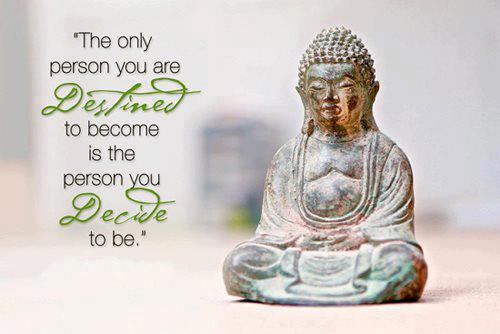
It’s ultimately your choice, so do ‘YOU’ need to make a change to ‘YOUR’ life?
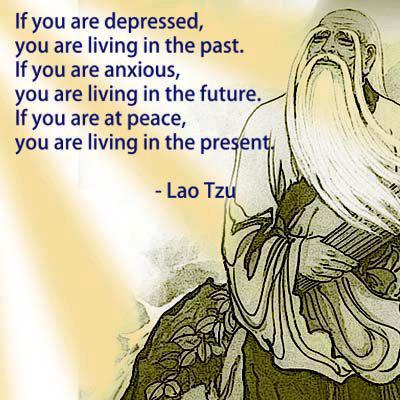
Lao Tzu is a particular favorite of mine and I have studied his writings but he is only one of many great sages that can offer you great advice and help you bring your thoughts into the NOW.
The Now is where you need to be, you need to be happy and content with who you are and where your life is taking you, if not then you need to make a change.
Please watch this short video and also send it on to all your friends and blogging contacts….
This video is about an island in the Pacific Ocean around 2000 km from any other coast line.
Nobody lives there, only birds and yet ……………
You will not believe your eyes!!!!!!!
This film should be seen by the entire world, please don’t throw anything into the sea. and urge your governments to stop dumping waste at sea…Unbelievable, just look at the consequences!!!!!
WE need to do something about this because our governments are certainly doing nothing other than talking!!!!
Namaste with Love for every creature on this Planet.
Unless and until we have peace deep within us, we can never hope to have peace in the world. You and I create the world by the vibrations that we offer to it. If we can invoke peace and then offer it to somebody else, we will see how peace expands from one to two persons, and gradually to the world at large. Peace will come about in the world from the perfection of individuals. If you have peace, I have peace, he has peace, and she has peace, then automatically universal peace will dawn.
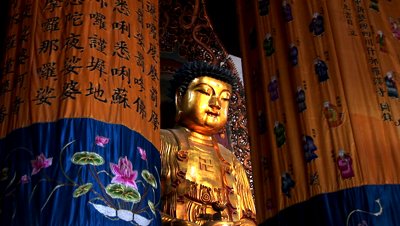
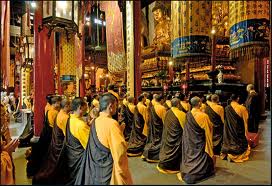
May and I are off to the Jade Buddha Temple in Shanghai today, today is the 5th day of January in the Chinese Nongli Calendar so the fifth day of the new year is the God of Wealth’s birthday.
In northern China, people eat jiǎozi (simplified Chinese: 饺子; traditional Chinese: 餃子), or dumplings, on the morning of pòwǔ (破五). In Taiwan, businesses traditionally re-open on the next day (the sixth day), accompanied by firecrackers. It is also common in China that on the 5th day people will shoot off firecrackers to get Guan Yu’s attention, thus ensuring his favor and good fortune for the new year., it’s also February 14th Valentines day in the Gregorian Calendar (Western Calendar) so we have plenty to pray for 🙂
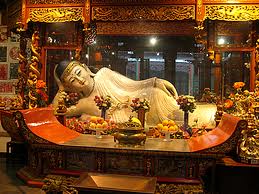
The Jade Buddha Temple (Chinese: 玉佛禅寺; pinyin: Yùfó Chán Sì, literally Jade Buddha Chan Temple) is a Buddhist temple in Shanghai, China. As with many modern Chinese Buddhist temples, the current temple draws from both the Pure Land and Chan traditions of Mahayana Buddhism. It was founded in 1882 with two jade Buddha statues imported to Shanghai from Burma by sea. These were a sitting Buddha (1.95 metres tall, 3 tonnes)
and a smaller reclining Buddha representing Buddha’s death.
The temple now also contains a much larger reclining Buddha made of marble, donated from Singapore.
I will pray for Peace, Happiness, Compassion, Good Health, Friendship and Love.























 Endless Light and Love